



Frontend as a Service: No-Code, Low-Code, or High-Code?
The eCommerce industry is consistently at the forefront of great software innovations. Fast and constantly changing consumer demands towards online retailers leave them with no choice. Along with growing challenges, such as the role of artificial intelligence in shopping, the number of possible solutions increases.
With growing challenges, the number of possible solutions increases. E-commerce business owners can literally buy ready-made solutions for every part of their online store's tech stack. This brings its own set of unique challenges: How to choose the right piece of OOTB (Out-Of-The-Box) software to build a super-efficient and unique eCommerce store?
All software exists on a code base. Whether you develop it yourself or use a solution with a ready code base and expand upon it. This is where you will have to decide whether you need a No-Code, Low-Code, or a High-Code solution.
In today's article, we will explain each of these solutions and the business benefits of choosing a High-Code FEaaS (Frontend as a Service) solution.
Listen to the audio version of this article.

Why start with the frontend?
In short; your eCommerce frontend is the part of your website that directly interacts with consumers from start to finish. This is where all other components of your modern tech stack must meet and work together to create a seamless shopping experience.
To summarize - the current state of eCommerce consumer requirements is simple. They want online shopping experiences to be:
Superfast
Multi-channel
Seamless
Personalized
Starting with a high-performance and optimized frontend, you can immediately improve the most important metrics for your store: customer experience, conversion rates, and revenue. You can expect a radical improvement by choosing the right frontend solution for your store, which is evident in the results of most existing case studies.
There is a big difference between No-Code, Low-Code, and High-Code eCommerce frontend solutions. Understanding these differences is essential so that you can choose the right solution for your business from the very beginning.
So, which type of frontend solution is right for you? It depends on your needs and budget. A No-Code solution may suffice if you need a simple solution with limited customization options. A Low-Code or High-Code solution may be better if you require greater flexibility and customization.
The global Low-Code/No-Code development platform market is expected to generate $187 billion in revenue by 2030. By 2024, it will account for over 65% of application development activity. A mix of Low-Code/No-Code and conventional innovations is predicted to be adopted by 75% of enterprises. UserGuiding
Choosing the right Frontend as a Service solution for your business is key to building the best online store and user interface for your target market. After reading this article, you should be able to differentiate your options and quickly make an informed decision.
Is your e-commerce holding back your growth?
See how our enterprise-class solutions eliminate technical debt and boost conversion rates!
Migrating to composable brings numerous benefits that increase customer satisfaction by:
Enabling easier scaling and improvement of website performance
Supporting a mobile-first architecture
Faster and more secure updates
Ensuring advanced personalization
Ensuring the highest flexibility
Read more about the benefits of headless commerce
A strongly composed journey should start with the storefront, as the frontend drives the customer experience.
What is Low-Code and No-Code FEaaS?
Low-Code and No-Code are two phrases describing application development methods. Both rely on using visual modeling to remove complexity from the system.
No-code and low-code tools enable many eCommerce businesses to create solutions with little or no technical knowledge. These tools help businesses in many ways, such as reducing costs and scaling. Although low-code and no-code procedures can be distinguished, they are often used interchangeably.
The target audience is the most significant distinction between low-code and no-code solutions. Developers are generally more interested in platforms with Low-Code capabilities. Business users, on the other hand, are typically more interested in No-Code platforms.
What is Frontend as a Service (FEaaS)?
FEaaS (Frontend as a Service) provides eCommerce companies with a one-stop-shop solution for creating efficient storefronts from build to launch. It gives them an ecosystem of cloud-native, microservices-based, and API-first (High-Code) frontend modules that your developers can combine into a fast-performing, easy-to-use solution.

eCommerce developers can create, test, and distribute engaging frontend experiences faster, better, and more economically thanks to a complete FEaaS solution. With FEaaS, you can build optimized, well-tested, and performant consumer-centric frontends without spending months developing a custom solution.
Using an end-to-end FEaaS solution can save a company months of time and up to $500,000 in development costs. Faster time-to-market leads to a lower TCO while increasing ROI and revenue.
So what are the differences between Low-Code and No-Code?
No-Code
All web applications, platforms, and technology solutions use code. However, in some cases, it is not visible to the users. These types of platforms are intuitive and instead feature visual components that allow for easy drag-and-drop application creation.

Low-Code
Low-code platforms feature drag-and-drop capabilities that make them malleable and scalable. They can also be manually coded in an open and extendable format if needed. This is a perfect scenario for developers, as they can have their cake and eat it too. They don't have to waste time replicating foundational code, so development happens fast.

In practice, low-code/no-code FEaaS solutions combine a CMS, page builder, and frontend. The trade-off is little customization potential for developers. It can be a good fit for small and medium-sized businesses that aren't tech-savvy and prefer to invest in marketing and sales until they scale. Patrick Friday, CEO at Vue Storefront
So, if a No-Code solution is only good for startups or small businesses, but Low-Code still stifles customization and personalization potential while creating vendor lock-in, what is the answer for commercial enterprises looking for the best FEaaS solution?
Well, I'm glad you ask. That leads us to the third option: The High-Code FEaaS solution.
What is a High-Code FEaaS Solution?
High-Code Frontend as a Service is a complex commercial solution that allows developers to use cloud-based modules to develop a high-performance eCommerce frontend.

High-Code FEaaS provides companies with a comprehensive frontend solution, an orchestration layer, various pre-built components and integrations, a cloud platform, and a core theme. This allows for a quick start and POC creation while simultaneously offering developers all the flexibility they need to customize the frontend application without any limitations.
High-Code FEaaS allows developers to customize the code and build highly differentiated stores with unique customer experiences, while also providing a comprehensive ecosystem of tools and applications to build an eCommerce store from build to launch.
Benefits of Using High-Code FEaaS
In today's eCommerce market, consumers (and Google) are looking for high-quality, unique, personalized, and super-performant shopping experiences. The "cookie-cutter" approach will not deliver the expected results in the long run.
This is where High-Code FEaaS provides a solution that allows for the rapid creation of unique stores and their deployment to the market in a fraction of the time, without sacrificing the ability to offer a truly unique store and customer experience.
The benefits include:
Enhanced Customer Experiences: Best-in-class FEaaS solutions provide optimized web performance and omnichannel microservices. Progressive Web App technologies are one way they achieve this. The main advantage of PWA is the superfast and omnichannel performance that meets today's headless customer demands.
Easy Implementation of New Features: The composable approach allows your developer (or your marketers) to add required functionality instantaneously.
Lower TCO & Increased Revenue: Since you opt for an ecosystem of effectively integrated tools and applications, you will spend less time and cost on development. Due to the highly performant nature of the selected technologies in a High-Code FEaaS solution, your store will be faster, your CX will improve, and conversion rates will increase, leading to increased revenue.
Faster TTM (Time-to-Market): By utilizing ready-made components, your developers can create a website or application in less time than it would take them to build it from scratch. Using an end-to-end FEaaS solution can help you launch a project up to eight months earlier than building it from the ground up. The ready-made architecture is optimized for web performance and is mobile-friendly. The cost and time savings are significant. Thanks to API integrations for every component of the tech stack, you can use best-in-class applications and quickly improve your site's web performance factors.
Flexibility: Pre-built frontend modules are fully configurable, giving developers complete freedom to tailor them to their needs and control the final result.
No vendor lock-in: One significant advantage of using an FEaaS solution is that it helps future-proof the store by remaining agnostic to all components. The flexibility to change vendors in the tech stack when necessary remains with the business owner. This allows for excellent customization of the store to needs.
Lower Hosting Costs: Your FEaaS provider should improve overall expenditure by offering a dedicated, well-managed, and comprehensive hosting and infrastructure solution.
Excellent Scalability: With the modular approach, you can drive growth for one feature or module without compromising the quality of others. This ensures efficient and reliable scalability. Not only can you modify any part of the site, but this flexible framework also makes it easier.
About Vue Storefront High-Code FEaaS Solution

Vue Storefront is a proven, comprehensive High-Code FEaaS solution that addresses all the challenges modern eCommerce businesses face. It will boost your site's performance, shape a highly personalized and customized customer journey, and unleash your developer's creativity. Vue Storefront is the best starting point for your eCommerce project for many reasons, the most important of which are:
Enhanced Customer Experience: Vue Storefront's PWA UI is built for speed and seamless operation from the moment your UI loads, through communication with all other APIs, right up to checkout. Your customers will enjoy an omnichannel shopping experience, regardless of the device they use.
Superfast Web Performance: Our frontend strongly focuses on meeting Google's Core Web Vitals ranking signals. The pre-built integrations with eCommerce platforms, CMS, search, other 3rd party tools, and cloud hosting are tested and optimized for peak web performance.
Mobile-first Architecture: A shift is occurring from web-platform-based commerce towards customer-centric mobile commerce. Vue Storefront provides fast, mobile customer experiences that multiply conversion and revenue.
If you want to fix your performance and conversion while creating and controlling the customer experience with an agnostic ecosystem of integrations and an API Orchestration Layer, you can easily gather your entire composable stack in one place with Vue Storefront.


Let's talk about potential areas of collaboration!
Hi!
during the first consultation we'll analyze your goals through the lens of ROI and operational risk. Whether we're building an Enterprise system, an application, or an AI automation — together we'll plan an architecture that eliminates your technical debt and unlocks scalability.


Read more about headless CMS

Headless CMS vs. Traditional CMS
How Do Traditional CMS Systems Differ from Headless CMS? Discover the Benefits of Implementation.
10 min
Read more

Comparison of Headless CMS and No-Code Website Builders.
Content management systems. Comparison of headless and no-code solutions.
6 min
Read more
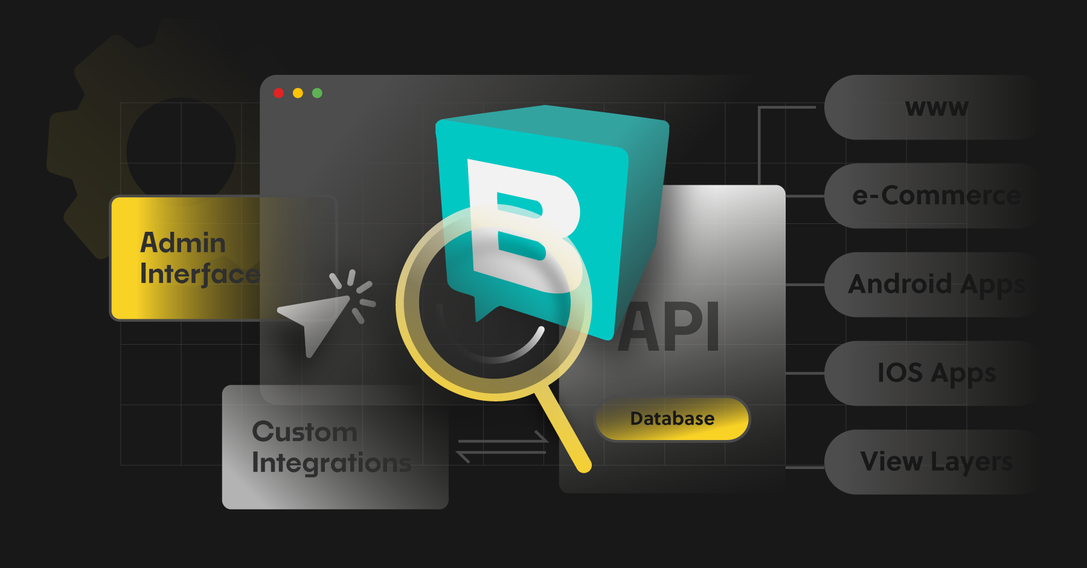
What is Storyblok? A simple guide to headless CMS for e-commerce and beyond
Storyblok is an effective tool for creating and managing website content. Read this post and learn how this intuitive headless CMS will impact your business growth.
5 min
Read more