




Tailwind CSS: Ending "CSS Hell" – How Utility-First Architecture Lowers TCO and Stabilizes Scalable Projects
In the frontend world, we rarely talk about what happens to a project after two years of intensive development. Most systems eventually fall into a trap we call CSS Hell. Stylesheets swell to thousands of lines, classes begin to conflict, and developers become afraid to delete even a single rule for fear of accidentally breaking a layout on the other side of the application.
This isn't just an aesthetic issue. It's a real business cost. Every hour spent debugging a waterfall increases your platform's Total Cost of Ownership (TCO). Tailwind CSS proposes breaking this cycle with a utility-first approach.
Listen to the audio version of this article.

Why Use Tailwind CSS to Avoid "CSS Hell"?
The global CSS cascade is a powerful tool that, in large systems without a strict methodology, becomes a curse. While approaches like BEM (Block Element Modifier) attempt to organize this chaos through rigorous naming, even the best semantic class-based architecture requires iron discipline. One must constantly ensure that changing a margin in a .card class doesn't unexpectedly impact the cart or the customer panel.
Tailwind CSS offers a different philosophy. It isn't a "magic shield" against chaos—success still depends on maintaining design rules—but it shifts the burden from inventing class names to the rigorous use of design tokens. Because styles are defined while designing interfaces directly in the HTML code, the developer is 100% certain that editing a specific product card affects only that single element.
For the business, this means:
Lower risk of regression
Style isolation prevents accidental layout breaks in other parts of the service.
Faster QA
Testers spend less time verifying changes because they don't have to guess where the source of a problem might lie.
Bolder development
Developers can iterate quickly without fearing technical debt hidden in global .scss files.

Solving the "Dead Code" Problem and Core Web Vitals Performance
One of the largest "hidden costs" of traditional frameworks and practices is the overhead of unused code. As a project grows, CSS files become heavier because developers typically only add new styles, rarely having the time to safely remove old ones (Dead Code).
The CSS file that stops swelling
Most importantly, Tailwind generates a resulting stylesheet containing only the rules you actually used. Consequently, designing responsive websites does not come with a performance penalty.
A lightweight stylesheet means faster rendering (LCP), which directly translates into better Core Web Vitals scores and a higher position in Google.
Is your e-commerce holding back your growth?
See how our enterprise-class solutions eliminate technical debt and boost conversion rates!
Ending "Naming Fatigue" and a New Focus on Code Review
Developers can waste hundreds of hours a year debating class names (e.g., .product-wrapper vs. .product-card-container). This phenomenon, known as "Naming Fatigue," brings no value to the end customer and only slows down the design process.
In Tailwind, this problem disappears at the stylesheet level, though it doesn't excuse the team from caring about semantics. To avoid "utility fatigue"—difficulty understanding an element's role due to an excess of classes—it remains key to give precise names to the components themselves.
There's also a common question: Tailwind CSS vs. Bootstrap, which to choose? While Bootstrap imposes pre-built components, Tailwind gives you complete freedom without the hassle of overriding framework styles.
In practice, with Tailwind the team gains flexibility, and the Code Review process shifts its focus:
Onboarding: A new programmer joining the project immediately understands the style structure without having to study a unique BEM architecture created by a predecessor.
Code Review: Attention is focused on business logic and component architecture rather than whether a CSS class name is "semantic enough."
Flexibility and Framework Configuration: Freedom Without Limits
One of the most serious challenges in long-term projects is maintaining visual consistency. Traditional methods often result in dozens of variables scattered across many files, making a global rebranding feel like open-heart surgery.
Unlike rigid frameworks like Bootstrap, which impose a ready-made look, Tailwind CSS offers much greater control while providing a wide set of built-in tools. Developers receive a robust foundation "out of the box":

A Design System
including spacing scales, font sizes, colors, and breakpoints.

Built-in Dark Mode and image filters.

A native Mobile-first approach and cascade handling.
This rich base of built-in standards makes changes to existing components simpler and more predictable. Refactoring runs more smoothly, and the lack of uncontrolled side effects allows for safe code modification even in highly complex systems.
Challenges and Trade-offs: Key Pros and Cons of Tailwind CSS
Tailwind CSS is not a flaw-free technology. We identify four significant barriers:
Visual Noise: Initial contact with HTML peppered with utility classes can be shocking. Class attributes become long, making it harder to scan the document structure quickly.
Startup Cost: It is an additional library requiring time for initial environment configuration.
Utility Fatigue: Without discipline, an excess of classes in HTML makes it hard to understand an element's role.
Code Review Oversight: The team must ensure classes are reused optimally and that the config is extended instead of adding "ad-hoc" styles.
Drawbacks of Tailwind CSS in smaller projects
To make the decision-making process easier, we have prepared a concise summary of when it’s worth considering Tailwind. Instead of treating it as a universal remedy, let’s look at it through the lens of specific project and team needs:
| Criteria | Choose Tailwind CSS |
|---|---|
| Ecosystem & libraries | If you work with React, Vue, or Next.js, most modern libraries are already Tailwind-based. |
| Large Teams | Tailwind introduces one common standard, eliminating chaos resulting from individual styling habits. |
| Time to Market | It offers a massive base of ready-to-use elements, drastically shortening the time from design to a working interface. |
| Architecture: | Ideal for component-based projects where refactoring speed and change safety are paramount. |
Summary: Tailwind CSS as an Investment in a Stable TCO
The choice of frontend technology should rarely be dictated by fashion alone. In the case of Tailwind CSS, the key argument is the control over the Total Cost of Ownership (TCO) in the long run. It realistically lowers maintenance costs by eliminating the most time-consuming stages of a developer's work.
Implementing a utility-first architecture translates into concrete savings through:
Instant Onboarding: New developers don't waste days learning unique CSS structures.
Process Optimization: No more "Naming Fatigue" means faster delivery of new features.
Less Code to Maintain: The stylesheet doesn't swell as the project grows.
SEO Performance: Lower file weight leads to better Core Web Vitals and higher e-commerce conversion.


Let's talk about potential areas of collaboration!
Hi!
during the first consultation we'll analyze your goals through the lens of ROI and operational risk. Whether we're building an Enterprise system, an application, or an AI automation — together we'll plan an architecture that eliminates your technical debt and unlocks scalability.


You can find more articles on this topic on our blog

Content Governance: How to Reclaim Your Team's Time and Unleash Content Marketing?
Implement effective content marketing and relieve your developers. Discover how content planning and Content Governance build organizational order in e-commerce.
4 min
Read more
Craft over Trends: Why Fundamentals are the Heart of Modern Web Development in 2026
In 2026, technology is all about craftsmanship. Discover the fundamentals, best practices, and modern web development trends that stay ahead of AI.
5 min
Read more
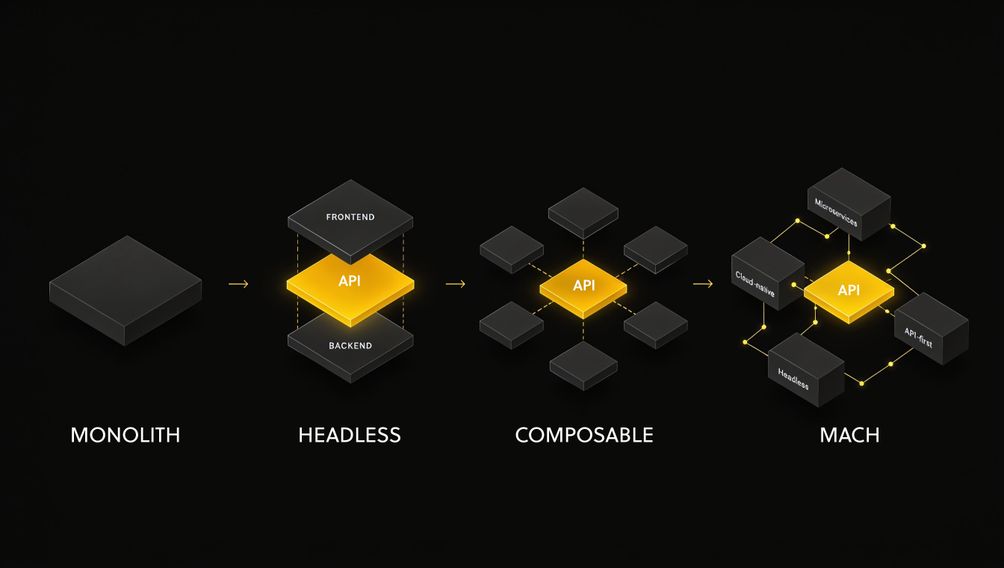
Headless, Composable, MACH. Which Differences Actually Move the Needle in 2026?
Headless, Composable, and MACH are three different decision layers, not synonyms. With 2026 numbers, we show when Headless is enough for the Polish mid-market and when it pays to go further.
9 min
Read more