




Technical Debt: The Hidden Cost of "Fast" Deployments. How to Stop Technology from Holding Your E-commerce Back?
Imagine that every new feature in your store today costs twice as much and takes developers twice as long to implement than it did a year ago. This isn't just inflation or rising specialist rates—it’s the interest on your technical debt. In the world of e-commerce, where time-to-market dictates survival, taking shortcuts often leads to a financial dead end.
Today, learn how to recognize technical debt and how to turn its management into a competitive advantage.
Listen to the audio version of this article.

What Exactly is Technical Debt in E-commerce?
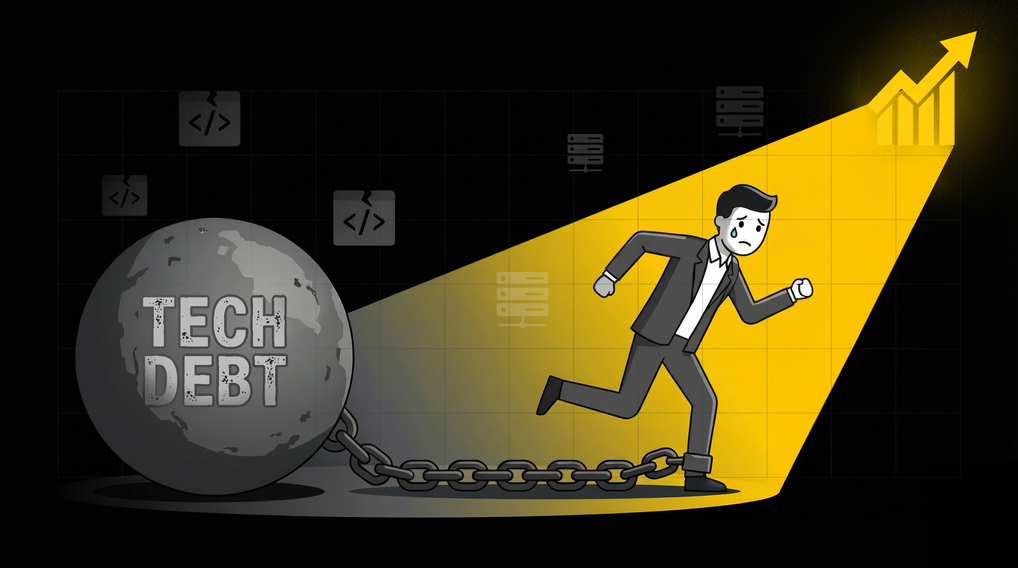
Technical debt is a metaphor introduced by Ward Cunningham, an American programmer and software engineering pioneer. In e-commerce, it refers to the conscious (or unconscious) choice of taking a shortcut: implementing a temporary workaround that provides a quick "right now" result but creates the need for future corrections.
Much like a bank loan, "borrowed" debt allows you to accelerate development. However, if it isn't paid back, the interest—in the form of more difficult development and recurring bugs—will eventually paralyze your business.
Why managing technical debt is a vital business decision
Many managers treat code as the exclusive domain of the IT department. This is a mistake. In e-commerce, top-tier software must be flexible; the alternative is falling behind the market. If we ignore accumulating errors, the stability of the entire sales ecosystem suffers.
For example, when deciding to rush a new feature, we often choose short-term gain. However, we must remember that every such step should be part of a larger plan. Managing debt isn't about avoiding it entirely—it’s about consciously planning when to "repay" those technical borrowings to maintain the company's long-term growth potential.
Is your e-commerce holding back your growth?
See how our enterprise-class solutions eliminate technical debt and boost conversion rates!
Where Does Technical Debt Come From?
Understanding the source of the problem is the first step toward eliminating it. In practice, we most often encounter three causes:
Time-to-Market Pressure: The urge to test a new feature before the competition leads to "duct-tape" solutions. It’s worth stating clearly: temporary fixes can be surprisingly long-lasting, but they always prove expensive.
Lack of Business–IT Communication: Inconsistent requirements force developers to build convoluted, roundabout solutions. Code written without a clear plan can become unreadable in just a few months.
Neglected Updates: Treating e-commerce as a one-time project rather than a continuous process. Failing to regularly update your engine (e.g., Magento, Shopify) or libraries is a direct path to a debt that eventually becomes impossible to repay without rebuilding the store from scratch.
System Integration – The Most Common Source of Debt
In modern online trade, no platform is an island. Every integration, whether with ERP, PIM, or marketing tools, is critical.
The Trap of Rigid Couplings: One must accept a technical fact: if an external partner changes their business logic or data structure, the integration will almost always "break", regardless of how well it was written. The key difference for your business isn't if the connection stops working, but how quickly and cheaply you can fix it.
Infrastructure Under the Microscope: We often forget that server infrastructure can also generate debt. Outdated database versions are not just a security risk, but a real barrier to your software's performance.
Warning Signs: Is Your Store Drowning in Debt?
Before technical debt paralyzes your sales department, it sends out warning signals. What should you look for?
Rising Costs: Simple changes that used to take one day now take a week.
Fear of Change: Developers warn: "Better not touch that, or the whole checkout might stop working."
The Domino Effect: Fixing one bug causes two new ones to appear in a completely different part of the system.
Knowledge Bottlenecks: Only one person in the company understands how a specific module works. If they leave, you are left with a "black box."

How to Repay Technical Debt?
Modern architecture is the most effective tool in the fight against debt. Here are the best practices for designing time-resistant systems:
Composable Commerce: Modularity over monoliths
Instead of one heavy, rigid machine, we build the store from "building blocks." With a Composable Commerce approach, you can swap out a payment module or search engine without tearing down the foundations of the entire castle.
Headless as a separator
Characteristic for Headless, decoupling the visual layer (Frontend) from the business logic (Backend) allows for independent development. Debt in the backend doesn't slow down UX/UI changes, keeping your sales dynamics high.
Automation and Testing
Investing in automated tests is your insurance policy. They allow for safe refactoring (cleaning up) of code, ensuring that technical optimization doesn't break sales functions.
Architecture Audits
Once a year, check if your technology stack still supports your business goals or if it has become a issue.
Debt Log
Keep a record of every place where you took a "shortcut." Conscious debt management starts with knowing exactly where the debt is located.
Roadmap Without Debt: Recommendations for E-commerce managers
Managing technology is, at its core, managing risk. Here are three golden rules to implement immediately:
The 80/20 Rule in Sprints: We recommend allocating roughly 20% of development time to refactoring. This "cleanup time" allows you to maintain a steady deployment pace in the future.
Regular Technical Audits: Sometimes you need a fresh pair of eyes to see what you’ve grown accustomed to. Once a year, invite an external partner to check the "health" of your system.
>> Here's where you'll read about online store audits <<
Investment in Modern Frameworks: Choosing technologies like Shopify Hydrogen (optimizing Headless performance) or Next.js (with a massive community and great documentation) minimizes debt creation right from the start.
Summary: The E-commerce Dilemma of 2026
Technical debt is an inseparable part of scaling an online business. The key is not to avoid it entirely, but to manage it consciously. A store that is regularly "serviced" not only runs faster but, above all, is cheaper to maintain in the long run.
Would you like to check if your e-commerce needs refactoring? Contact Beecommerce, and we will conduct an audit and help you plan a development path that won't be held back by the mistakes of the past.
FAQ: Managing Technical Debt in E-commerce
Technical debt in e-commerce is the consequence of using quick, temporary technical workarounds that, over time, hinder the development, scaling, and maintenance of a sales platform. It manifests through slower store performance, higher costs for making changes, and an increased risk of bugs or system failures.
Vulnerabilities should be identified through regular technical code reviews and systematic monitoring of system performance. This practice ensures that the software remains stable and efficient.
To manage technical debt wisely, you must maintain high code quality and allocate consistent time for refactoring. Repayment cannot be deferred indefinitely, as the "interest" costs will eventually skyrocket.
Yes, excessive debt makes it significantly harder to adapt the store quickly and implement market innovations.


Let's talk about potential areas of collaboration!
Hi!
during the first consultation we'll analyze your goals through the lens of ROI and operational risk. Whether we're building an Enterprise system, an application, or an AI automation — together we'll plan an architecture that eliminates your technical debt and unlocks scalability.


You can find more articles on this topic on our blog
Headless Commerce for B2B in 2026: Which Features Actually Move the Needle?
Discover the game-changing headless commerce features reshaping the B2B landscape in 2026. Learn how unparalleled flexibility and hyper-personalization can rapidly drive your sales growth. Click through to read the full article and stay ahead of the competition!
8 min
Read more
When Migrating to Magento Headless Makes Sense? 7 Measurable Criteria in 2026.
When should you migrate to Magento Headless? Discover 7 measurable criteria for 2026 and see if your e-commerce is ready for the switch. Read the article!
10 min
Read more
Headless Commerce vs. Shopify Plus in 2026: When Migration Makes Sense and What It Costs in Poland
When does migrating from Shopify Plus to headless make sense? Costs in PLN, GMV thresholds, 18–24 month break-even, and 4 paths for Polish SMBs in 2026.
12 min
Read more