

Headless Commerce for B2B in 2026: Which Features Actually Move the Needle?
TL;DR
The global B2B e-commerce market is pegged at roughly $36 trillion in 2026 (Shopify; Mordor Intelligence projects it climbing to $61.66 trillion by 2031). Poland, per Trade.gov, was already clocking $90 billion in online B2B turnover back in 2022 — but that's the broad definition, which lumps in EDI feeds and old-school wholesale catalogs; under the narrow definition (transactions actually running through a commerce platform), Mordor's numbers come in significantly lower. When you're talking to the C-suite, pick one definition and stick with it the whole way through.
B2B procurement in Poland is growing faster than retail — a 9.6% CAGR through 2031 (Mordor Intelligence, January 2026).
Most B2B shops in Poland are still essentially B2C engines with "wholesale pricing" bolted on. Five features that genuinely separate B2B from B2C: punch-out (cXML/OCI), contract pricing, approval workflows, company accounts with role hierarchies, and Net 30/60/90 plus proforma invoicing.
Headless commerce doesn't pay for itself "just because." A reasonable threshold for taking it seriously: at least 50 company accounts, B2B GMV north of PLN 8 million a year, or a real integration with the buyer's procurement system (SAP Ariba, Coupa, Jaggaer).
In the Polish market in 2026, a full B2B headless build lands in the PLN 300,000–900,000 range, while Discovery + MVP can start as low as PLN 45,000–220,000.
According to the MACH Alliance (February 2026 report, "AI: From Pilot to Production"), companies that are fully composable hit measurable AI outcomes 6× more often than companies just getting off the starting line (78% vs. 13%, n=600 IT decision-makers).
B2C with Bigger Carts Isn't B2B
It's 2026, and most Polish wholesale shops are still running on an engine built for a single consumer paying with a credit card, BLIK, or cash on delivery. A buyer at a mid-sized manufacturing company spends a solid half hour placing an order for 180 SKUs — simply because the system can't import a file out of their ERP. The invoice goes out by email, as an attachment. Prices have to be "unlocked" by a sales rep, often over the phone. This isn't an inconvenience — it's a bottleneck that millions of złoty flow through every single month.
The data tells a clear story. According to Trade.gov, Poland's B2B e-commerce market already hit $90 billion in 2022 and is outpacing retail (Mordor Intelligence, January 2026: B2B is projected to grow 9.6% annually through 2031). Globally, Shopify pegs the B2B market at around $36 trillion — and corporate buyers, the same people who knock out an Allegro purchase in 12 seconds at home, expect the same frictionless ride at work.
The thing is, buying for a company is a different animal altogether. It's a team process — contractual, auditable, repeatable. B2B isn't B2C with extra complexity tacked on; it's a different domain with its own rules. That one sentence is the thesis of this entire article, and we'll keep circling back to it.
What Makes B2B Different from B2C — Five Things That Change Everything
Let's start with something that sounds obvious on its face but rewrites the entire architecture underneath. In B2C, a person buys. In B2B, a process buys. A consumer clicks "order" and pays by card, and that's the end of it. At a company, the order is placed by a procurement specialist, signed off by a department head, vetted by finance against the contract, and then confirmed by the warehouse on delivery. Five roles, five screens, five document states — and every step has to be logged, because the audit is always right around the corner.
Second difference: price isn't a price, it's a contract clause. The same SKU might carry twenty different prices in a single B2B store, depending on who's looking — framework contract, trailing-twelve-month volume, region, buyer's brand, quarterly promotion, export policy. Adobe, as one of the procurement engine vendors, lays it out plainly in its documentation: B2B pricing is rarely a single price list; it covers negotiated contracts, regional rates, and per-customer assortments.
Third is the integration with the buyer's procurement system. This is where punch-out comes in — a mechanism that lets a buyer "jump out" of their SAP Ariba, Coupa, or Jaggaer environment straight into your store, build a cart, and bounce back to their system after checkout with a fully formatted order in hand (cXML or OCI). If you're selling to large corporations, no punch-out means no seat at the table — no matter how slick your frontend is or how fast your backend runs.
The clearest way to see the gap is one table — what out-of-the-box B2C platforms give you versus what B2B actually needs:
| B2B Requirement | Typical B2C Store | What B2B Actually Needs |
|---|---|---|
| Pricing | 1 price per SKU | Contract, volume, segment, and regional pricing |
| Payment | Card, BLIK, transfer | Net 15/30/60/90, proforma invoicing, trade credit |
| Customer account | 1 person = 1 account | Company account + N buyers with different roles |
| Order approval | None (click = order) | Workflow with spend thresholds and a hierarchy |
| Buyer procurement integration | None | Punch-out (cXML, OCI), EDI 850/855/856/810 |
| Reorder | Order history | Quick-order lists, CSV import, MOQ |
This isn't a wish list — it's the bare minimum a buyer at a mid-sized manufacturer expects today. The fourth and fifth differences round out the picture: company accounts with hierarchy (one company, ten buyers, four approvers, one controller) and deferred payment terms. According to Shopify's April 2, 2026 announcement, merchants using native B2B see reorder frequency up to 4.1× higher than DTC, plus up to a 33% lift in self-serve order share in the first six months.
Is your e-commerce holding back your growth?
See how our enterprise-class solutions eliminate technical debt and boost conversion rates!
Punch-out, cXML, and OCI — The Feature That Gets You Through the Enterprise Door
Let's pause here for a moment, because this is exactly where most Polish B2B shops are bleeding money without ever realizing it. Punch-out sounds technical, but the logic behind it is dead simple: a buyer at a large corporation can't go outside their procurement system. Full stop. It's not a preference — it's compliance and audit. If your store can't "talk" to SAP Ariba, Coupa, or Jaggaer in cXML or OCI, you simply don't exist as far as procurement teams at major corporations are concerned.
Here's how it shakes out in practice: the buyer logs into their procurement tool, clicks your supplier name in the catalog, and the system redirects them straight to your store (already logged in, with their contract pricing applied), builds a cart, clicks "Transfer Cart" — and lands back in procurement with a ready-made order queued up for the rest of the approval workflow. You then receive the official PO, send the invoice, and sometimes ship an ASN (Advance Ship Notice) on top of all that. The whole pipeline is documented and auditable end to end.
In Magento Open Source you bolt on a module like TradeCentric (formerly Punchout2Go) or Punchout Catalogs — a fraction of the cost of an Adobe Commerce license, with the same functional payoff. Adobe Commerce ships with it natively, and so does OroCommerce. cXML/OCI support is one of the top criteria for picking a B2B agency in 2026 — right alongside EDI 850/855/856/810. Without it, you're building for the midmarket only.
When Headless Pays Off, and When It's More Sizzle Than Steak
Back to the thesis from the intro: B2B is a different domain, so the platform should be different too. But headless in B2B isn't a silver bullet — it's a tool that makes sense above a certain scale and below a certain level of organizational chaos. Let's be honest: most mid-sized Polish companies don't need full composable.
The three sensible paths in 2026 look like this:
| Path | Who it's for | Implementation cost | 3-year TCO |
|---|---|---|---|
| B2B monolith + Net Terms (Shopify B2B on the new plans, BigCommerce B2B Edition) | < 50 company accounts, simple pricing, one market | PLN 80,000–250,000 | PLN 350,000–700,000 |
| Magento Open Source + headless frontend (Hydrogen, Next.js, Storyblok CMS, custom React frontend) | 50–500 company accounts, contracts, B2B+B2C, ERP integration | PLN 250,000–600,000 | PLN 800,000–1.5 million |
| Full composable (commercetools or OroCommerce + Storyblok CMS + custom frontend) | 500+ accounts, multi-market, punch-out, deep ERP, in-house PIM | PLN 600,000–1.5 million | PLN 1.8–3.5 million |
A note that doesn't jump off the table: in practice, 6 out of 10 Polish B2B projects shooting for full composable end up landing on the middle path — Magento Open Source with a headless front. That's the good news, because that option usually gives you the best bang for your buck on flexibility. Magento Open Source as a B2B engine — with custom-built company account hierarchy, custom price lists, and approval workflows — plus a fast headless front (Next.js or custom React wired to a headless CMS like Storyblok) gets you 80% of composable's benefits at 40–50% of the price.
That's Beecommerce's default recommendation for mid-sized B2B shops in 2026. We leave Adobe Commerce to the folks with enterprise-grade IT budgets who really do need native Shared Catalogs and Negotiable Quotes "right out of the box" — in most other cases, the license simply doesn't pay for itself over the project lifetime.
Headless makes sense when: you have at least 50 active company accounts, you're planning to integrate with customer procurement, you sell in 2+ markets, you've got a 10K+ SKU catalog with contract pricing, and you want to decouple frontend release cycles from the backend.
Headless is overkill when: you have fewer than 30 company buyers, one market, simple pricing (3–5 customer groups max), no integration with their procurement systems, and an IT team of 1–2 people. In that scenario, optimizing the frontend on your existing Magento usually delivers a better ROI than a full replatform.
What It Actually Costs in Poland in 2026
Now that we know when headless actually makes sense, the natural follow-up question is: what does it really cost? Poland isn't Germany or the Netherlands — implementation rates here run 30–40% lower than in DACH or Benelux, but the functional requirements on the table are identical. That's paradoxically our edge: a solid 3-person team in Kraków delivers a full B2B headless build for what Discovery alone covers in the West.
Concrete ranges for the Polish SMB market in 2026:
| Project phase | Cost | Timeline |
|---|---|---|
| Discovery + technology audit (B2B process map, integrations, ROI) | PLN 30,000–60,000 | 4–8 weeks |
| B2B Headless MVP (one market, basic company accounts, 2–3 price lists, Net 30) | PLN 180,000–280,000 | 3–5 months |
| Full rollout with punch-out, ERP, multi-market, approvals | PLN 350,000–650,000 | 6–9 months |
| Annual maintenance (2–3 developers + part-time DevOps) | PLN 380,000–650,000 | — |
These numbers aren't pulled out of thin air — they map directly to senior developer rates of PLN 180–250 per hour and a 4–6-person team running a typical 6-month cycle. Adobe Commerce in its Enterprise tier additionally runs $22,000–$190,000 per year on the license alone (industry estimates for 2026, GMV-based model), and TCO usually clocks in at 2–3× the license value once everything is said and done. OroCommerce and commercetools start lower on the price tag, but they demand a bigger dev team to make them sing. Magento Open Source starts at zero on the license side — the entire budget goes into the implementation team, which for most Polish SMBs is much healthier math than fixed license fees. Corporations, on the other hand, know the upside of licensing and often prefer it.
Break-even for a typical Polish B2B headless project lands in the 18–28 month range, provided GMV exceeds PLN 12 million annually. That's twice as fast as Western markets — largely thanks to lower hourly rates.
Closing Thoughts: The Question to Ask Yourself Before Drafting an RFP
Once you've walked through the features, the paths, and the costs side by side, it becomes pretty clear that this isn't really a choice between "modern" and "old." It's a choice between an architecture designed from the ground up around a corporate buying process and an architecture that pretends a company is just a consumer with a fatter wallet. B2B is a different domain, so the platform should be different — that thesis from the intro isn't a slogan, it's a practical decision criterion.
Before you start drafting that RFP, ask yourself four questions:
Do my B2B customers place orders out of a procurement system (punch-out)?
Do I have more than 50 active company accounts with individual price lists?
Am I planning to enter a second market within 18 months?
Does my competitive edge live in frontend speed and process flexibility — or in low prices and simplicity?
If you answered "yes" to most of these, headless — most likely the Magento Open Source with headless frontend flavor — is a real investment, not a fad. If "no," save your money and clean up the Magento you're already on. Either way, start with a technology audit before anyone tries to sell you a replatform.
FAQ
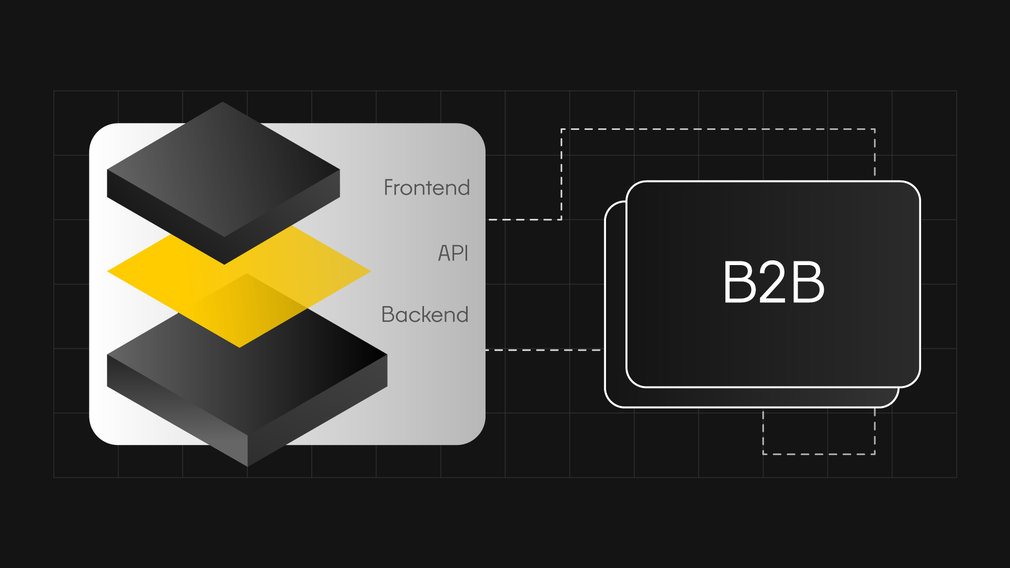
Headless commerce is an architecture where the frontend (the display layer, e.g., Next.js, Hydrogen) is decoupled from the backend (the commerce engine — Magento, commercetools, OroCommerce, Shopify Plus) and talks to it through APIs. In B2B, this delivers two concrete benefits: a fast, role-tailored frontend for the buyer, and the ability to integrate independently with ERP, PIM, OMS, and customer procurement systems.
Yes — the most common play is to run the old store and the new frontend in parallel on a chosen market or segment. Discovery (4–8 weeks) + MVP on one market (3–5 months) + gradual migration of company accounts (2–4 months). The risk of losing sales is minimal as long as the data migration plan is solid.
For fewer than 50 company accounts, simple pricing, and one market — often, yes. The standard plans (Basic, Grow, Advanced) give you 3 active price catalogs assigned at the market level, no punch-out, and no unlimited catalogs (those stay locked behind Shopify Plus, along with partial payments and deposits). Above that scale, you'll need either Shopify Plus or a different platform.
On Magento with an off-the-shelf module (TradeCentric, Punchout Catalogs) — 4–8 weeks of testing per customer procurement system (SAP Ariba, Coupa, Jaggaer). Every customer running a different procurement tool is a separate QA cycle.
For the overwhelming majority of Polish SMBs — Magento Open Source, hands down. True, it doesn't come with native company accounts, Shared Catalogs, or Negotiable Quotes — you have to build them. But for a team that works with Magento day in and day out, that's neither particularly hard nor particularly costly. At Beecommerce we do these implementations regularly, and in the 50–500 company-account range, Magento Open Source with solid architecture beats Adobe Commerce on TCO by 30–50%. Adobe Commerce only starts to make sense when you've got an enterprise IT budget, several hundred-plus company accounts, and an in-house team for whom an Enterprise license ($22,000–$190,000 per year) is basically pocket change. For everyone else, it's an indulgence you can comfortably skip.
Yes, but it demands a clear architectural call. Shopify Plus and Adobe Commerce handle it natively. In composable, you need two frontends (DTC + B2B) on a shared backend, with two checkouts and separate pricing logic. Cost: 20–35% on top of a pure B2B build.
Three metrics that actually show the impact in plain numbers: reorder frequency (Shopify reports up to 4.1× higher vs. DTC for merchants using B2B), self-serve share of orders (target: >60% within 12 months), and time from login to PO submission (target: <4 minutes for repeat carts).


Our Experts

Frontend Developer with hands-on experience in Magento and Shopify. One of the few Storyblok implementation specialists in the market. At Beecommerce for 8 years.

Senior Full Stack Developer with 20 years of experience. Expert in PHP, Java, and Python. Certified Magento specialist with 7 years in the platform.
Let's talk about potential areas of collaboration!
Hi!
during the first consultation we'll analyze your goals through the lens of ROI and operational risk. Whether we're building an Enterprise system, an application, or an AI automation — together we'll plan an architecture that eliminates your technical debt and unlocks scalability.


You can find more articles on this topic on our blog
Headless CMS for Marketing 2026: E-commerce Guide
Discover how Headless CMS transforms e-commerce and marketing. A complete guide for store owners and managers, including Storyblok and ROI.
8 min
Read more

Comparison of Headless CMS and No-Code Website Builders.
Content management systems. Comparison of headless and no-code solutions.
6 min
Read more

Headless Technology on a Traditional E-commerce Platform
Headless Online Store vs. Traditional E-commerce Platform: How to Go Headless Before Implementing Composable Technology.
6 min
Read more