



Headless, Composable, MACH. Which Differences Actually Move the Needle in 2026?
TL;DR
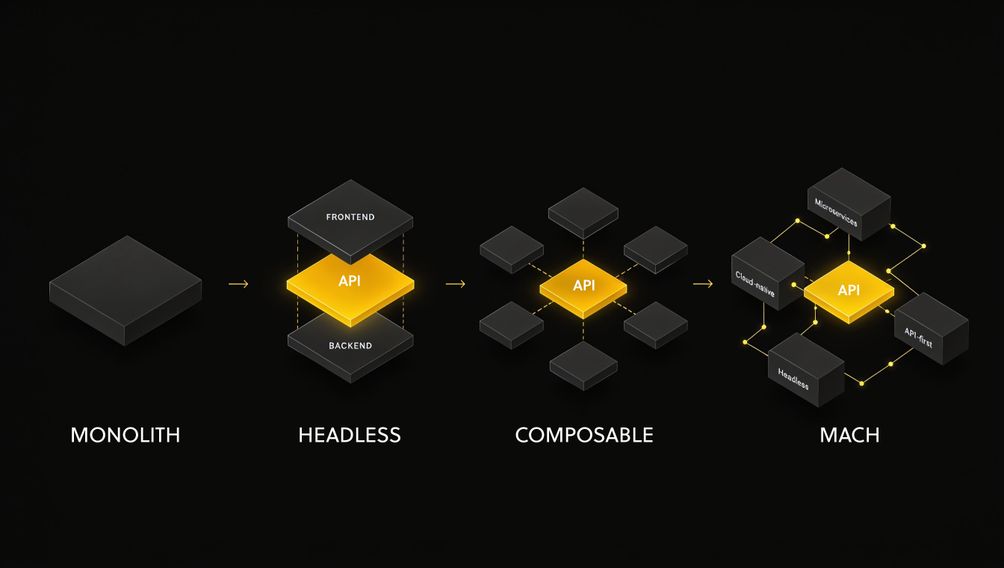
Headless, Composable, and MACH aren't competing approaches—but they aren't the same thing either. Headless is an approach: splitting the front end off from the back end. Composable is a broad family of architectures in which the back end breaks apart into modules. MACH is a design philosophy (Microservices, API-first, Cloud-native, Headless) that a Composable build may or may not be built on.
Per the MACH Alliance 2025 study (561 director-level-and-above IT decision-makers, exclusively from companies with 5,000+ employees and $500M+ in annual revenue), 9 out of 10 MACH rollouts meet or beat ROI expectations; by 2026, on average 61% of respondents' tech stacks are expected to be MACH-based.
Shopify Plus starts at $2,300/mo (3-year contract). Above roughly $800K in monthly GMV, the so-called variable platform fee kicks in—per Shopify partner agencies, 0.25%–0.40% of revenue, capped at $40,000/mo (Shopify doesn't officially publish either the threshold or the rate).
Commercetools (full composable) starts at around $40K/year for Core Edition; Premium runs from about $150K/year—a different league than Shopify Plus.
For the Polish mid-market (GMV PLN 5M–30M), Headless covers 80% of cases; full MACH only earns its keep once you're juggling 3+ markets and serious B2B.
Three words, three different things
Headless, Composable, MACH—in Polish conversations about e-commerce architecture, these three words get tossed around like synonyms, like rivals, or like a conference-slide buzzword you "have to have on the roadmap." In reality, they're three different things. And they don't compete with one another. Headless is an approach to decoupling the front end from the back end. Composable is a broad family of architectures in which the back end is broken down into interchangeable modules. MACH is a design philosophy you can build components against—whether for a full composable stack or a single service. They differ in cost of entry and in which business problem they actually solve.
Let me show my cards up front, since I'll be arguing it anyway: most mid-sized Polish stores should stop at Headless. For enterprise outfits with a portfolio of markets and complex B2B, the math usually plays out differently—but even there, full MACH demands a concrete business case, not faith in a trend.
This piece isn't about which solution is "better." It's about where Headless ends, what Composable actually is, how MACH fits into all of it—and how to match the level of decoupling to the size of the store. We're doing this with 2026 numbers, not vendor marketing decks.
Are Headless, Composable, and MACH the same thing?
No—they're three different beasts of different kinds. Easy to mix up because they overlap on the surface, but the technical consequences of each are different.
Headless means exactly one thing: the front end is separated from the back end and talks to it strictly through APIs. Everything happening "behind the API"—products, orders, inventory, customers—can still sit in a single monolith. Classic Headless looks like this: Magento or Shopify stays put, and you bolt on a new front end built in Hydrogen, Alokai, Next.js, or Nuxt.
Composable isn't a single solution—it's a broad family of architectures in which the back end breaks down into independent "best-of-breed" services. CMS on its own (Storyblok), search on its own (Algolia), payments on their own (Stripe or Adyen), PIM on its own (Akeneo), order engine on its own (commercetools or Medusa.js). All wired together by APIs. Specific composable stacks differ in how many modules you've swapped out and how they're built.
MACH isn't a product or a technology. It's a design philosophy—an acronym for Microservices, API-first, Cloud-native, Headless. If the components of your stack hit all four principles, the architecture is "MACH-compliant." Composable is very often built on the MACH paradigm, but it doesn't have to be—you can have a modular back end where one of the services is, say, self-hosted and not cloud-native. MACH speaks to how the components are built, not how many of them there are.
Worth flagging something that isn't any of the three but keeps coming up in this conversation: Hyvä Themes for Magento is a rebuilt front end on classic MVC architecture (PHP + AlpineJS + TailwindCSS). It isn't headless—there's no API split between front and back. It's simply a much faster alternative to the default Luma theme. Hyvä's own creators position it as "a sensible alternative to headless/PWA solutions." The distinction matters because Hyvä fixes the performance problem in one stroke, but it doesn't give you the architectural freedom that Headless does.
The easiest way to see this is through the specific configurations we run into with Polish merchants:
| Configuration | What's separated | Typical example |
|---|---|---|
| Monolith | Nothing—everything in one codebase | Magento 2.4.x with Luma theme, classic Shopify |
| Optimized monolith | Nothing, but the front end rewritten for performance | Magento + Hyvä Themes |
| Headless | Front end from back end | Shopify + Hydrogen, Magento Headless + Next.js, Alokai |
| Composable | Front end + each back-end function on its own | Storyblok + Algolia + commercetools + Adyen |
| Composable on a MACH-compliant stack | Same as Composable, plus every component hits all four MACH principles | Full commercetools rollout + MACH-certified ecosystem |
Most conversations about "migrating to composable" are really about moving from monolith to Headless—and that alone is enough to fix 80% of the performance and front-end headaches Polish merchants walk in with.
Is your e-commerce holding back your growth?
See how our enterprise-class solutions eliminate technical debt and boost conversion rates!
How does Headless actually differ from Composable and MACH in practice?
If the differences are structural, the consequences are too. And here's the part most generic articles skip: each of these dimensions solves a different problem and carries a different set of costs.
Headless solves the front-end problem. If the store has an old, slow, hard-to-edit UI but the back end (Magento, say) is holding up just fine—Headless is the cheapest path to a modern user experience. LCP under 1.5 s, room to run in React/Next.js, a front-end team that runs independently of the back-end team. A Magento Headless or Shopify Hydrogen rollout typically wraps in 3–6 months and doesn't require tearing the whole org apart.
Composable solves something else: vendor lock-in and functional bottlenecks. If platform search can't keep up at 100K SKUs, if the CMS can't handle 5 languages, if the checkout engine chokes on complex B2B discount logic—then it makes sense to pull individual components and replace them with category leaders. The price you pay is integration complexity and the overhead of managing more SaaS contracts.
MACH layers on yet another dimension: operational maturity and how the components are built. It demands a team that knows its way around Kubernetes, CI/CD, observability, SLA contracts with multiple vendors, and a "every service has an owner" culture. That's no longer just a decision about what you assemble on the back end. It's an organizational decision about how those pieces are built in the first place.
Notice what's missing from this story. Nobody is saying any of these dimensions is "better." Because none of them is. Each is either a good fit or a bad fit for the scale and the goals. A Polish manufacturer doing PLN 8M GMV in a single market doesn't need MACH. They need a faster front end and a better CMS.
What do the 2026 numbers actually say?
Vendor decks are one thing; the numbers in the wild are another.
According to the MACH Alliance Global Annual Research 2025 (an M·E·L Research study of 561 senior IT decision-makers, director-level and above), 9 out of 10 organizations that have deployed any MACH technology report it meets or exceeds ROI expectations—up 7 percentage points year over year. On average, 61% of respondents' tech stacks are expected to be MACH-based by the end of 2026. Gartner projects that 70% of organizations will be required to acquire composable DXP technology by 2026 (versus 50% in 2023).
Sounds like a tidal wave. Except the MACH Alliance study has a narrow sample: only companies with at least 5,000 employees and $500M in global annual revenue, drawn from the US, UK, Germany, France, Canada, and Australia. For the Polish mid-market (GMV PLN 5M–80M, IT team under 10 people), that's reference data, not a playbook. Full MACH was designed for portfolios of markets, not single-market B2C plays.
On price, the gaps are dramatic. Shopify Plus starts, per Shopify's official pricing, at $2,300 per month on a 3-year contract ($2,500 on a 1-year). Above roughly $800K in monthly GMV, the variable platform fee kicks in—Shopify doesn't publish the rate officially, but partner agencies report 0.25%–0.40% of revenue (sources and contract editions vary), capped at $40,000/month.
commercetools—the flagship composable player—prices annually and, depending on the source and edition, starts at around $40,000/year (Core), running to roughly $120,000/year at $100M GMV, up to $150,000+/year for Premium Edition.
The easiest way to see this gap is through three typical Polish-market scenarios:
| Scenario | Annual platform license | What you get | Realistic alternative |
|---|---|---|---|
| Small store (GMV < PLN 30M) | PLN 0–110K (Shopify Plus 3-year / Magento Open Source) | Stable monolith | Shopify Headless on Hydrogen, or just Hyvä on Magento—no back-end change |
| Mid-market (GMV PLN 30M–80M, 1–2 markets) | PLN 110K–350K (Shopify Plus + possible variable fee / Adobe Commerce quote-based) | Safe foundation, limited flexibility | Headless with best-of-breed CMS (Storyblok) and search (Algolia) |
| Enterprise (GMV PLN 100M+, 3+ markets, B2B+B2C) | PLN 350K–1M+ (commercetools, Adobe Commerce Cloud, full MACH stack) | Modularity, no lock-in, AI-ready | Full Composable / MACH, phased |
A point that's easy to miss in tables like this: between "small" and "enterprise" in the Polish mid-market, Headless or semi-composable is usually plenty. Full Composable on a MACH-compliant stack only starts paying for itself once Shopify's variable fee or Adobe's quote runs higher than the commercetools annual license—and that's at GMV closer to PLN 100M than PLN 30M.
When to stop at Headless and when to keep going
This is the question you're most likely waiting to hear an answer to—so let's get concrete. Every architecture decision should fall out of answers to five questions: what's the current state, what's the technical debt, what does the team know how to do, what's the scale of the business, and what's the plan for the next 24–36 months.
The cleanest way to lay this out is a two-column comparison: when Headless really is enough, and when it starts to pinch. The more green flags on the right, the stronger the case for moving toward Composable.
| Criteria | When Headless? | When Composable / MACH? |
|---|---|---|
| Annual GMV | < PLN 30M | > PLN 80M, with a plan to scale |
| Number of markets | 1–2 | 3+, with local payment methods and regulations |
| Model | B2C or simple B2B | Complex B2B (punch-out, contracts, buying hierarchies) |
| SKU count | < 50K | 100K+, multi-catalog |
| IT team | 1–3 developers + agency | In-house team of 5–10 with DevOps |
| Bottleneck | Front end, performance, UX | Bottlenecks across multiple modules at once |
| Time-to-market | Fine, reasonably quick | New features take months in the monolith |
| 36-month plan | Organic growth, single segment | Expansion into new markets, B2B, AI-driven personalization |
The table says something the composable-vendor decks rarely do: most mid-sized Polish merchants have most of their boxes checked on the left. Jumping to full Composable + MACH without those arguments is overengineering—paying a premium for flexibility you'll never use.
There's also a third path that often wins out in the Polish mid-market: going step by step. You start with Headless on your existing back end. A year or so in, if you're growing and the limits start to show, you swap out the first component—usually the CMS—for a standalone tool like Storyblok. Then maybe search for Algolia. That's real composable: rolled out piece by piece, not in one giant bang. That's exactly how we design Headless migrations for Polish clients—a 4–8 week discovery phase, an MVP on one channel, and only then the buildout.
Full Composable on a MACH-compliant stack makes sense when the organization is ready not just technically but culturally: it owns its architectural model, runs integration governance, and has the in-house chops. Without that, even the best composable stack devolves into spaghetti managed by whoever's the last dev to remember how it was all stitched together.
Key takeaways
Headless ≠ Composable ≠ MACH. Headless is an approach that separates the front end from the back end. Composable is a family of architectures with a modular back end. MACH is a design philosophy (Microservices, API-first, Cloud-native, Headless) that Composable may or may not adhere to.
Hyvä Themes isn't Headless—it's a fast theme on Magento's classic MVC architecture. It solves the performance problem but not the architecture problem.
80% of mid-sized Polish merchants (GMV PLN 5M–30M) need Headless, not full Composable. Full Composable / MACH starts paying off closer to PLN 100M GMV, 3+ markets, and complex B2B.
Shopify Plus: $2,300/mo (3-year contract), variable fee 0.25%–0.40% above ~$800K monthly GMV, capped at $40,000.
commercetools: $40K/year (Core), about $120K/year at $100M GMV, $150K+ (Premium).
Phasing wins. Per MACH Alliance data, companies rolling out composable incrementally hit 40% faster releases and lower project risk.
MACH Alliance data covers companies with 5,000+ employees and $500M+ revenue—not a benchmark for the Polish mid-market, but useful context.
Bottom line: match the solution to the problem, not the trend
Back to the thesis from the top. Headless, Composable, and MACH aren't competitors or variants of the same thing. Headless is an approach that separates the front end. Composable is a family of architectures in which the back end breaks down into modules. MACH is the philosophy for building those components—microservices, API-first, cloud-native, headless. Each dimension delivers something different, costs something different, and asks something different of the organization.
Most mid-sized Polish merchants only need Headless—and that's enough to fix the real problems: a slow front end, a rigid UI, weak Core Web Vitals, a clunky content workflow. Jumping straight to full Composable on a MACH stack is like swapping out the entire engine and chassis when the car just needed new tires and a smoother transmission.
So ask yourself a concrete question before you start: which component of my current architecture is blocking me right here and now, and which one will only start blocking me 24 months from now? The answer dictates how far you need to go—not a conference, not a Gartner report, not a buzzword on a slide.
FAQ
No. Headless is an approach that separates the front end from the back end—the back end can still be a monolith (Magento, for example). Composable is a broader family of architectures in which the back end breaks down into independent services (CMS, search, payments, PIM). In practice, every Composable setup is Headless, but not every Headless setup is Composable.
No. MACH is a component-design philosophy (Microservices, API-first, Cloud-native, Headless)—it speaks to how components are built. Composable is a family of architectures with a modular back end—it speaks to what the stack is made of. Most modern Composable rollouts are built on the MACH paradigm, but you can do Composable without full MACH compliance (without full containerization, for instance).
No. Hyvä is a rebuilt front-end theme on Magento's classic MVC architecture (PHP + AlpineJS + TailwindCSS), with no API separation between front and back. Hyvä's creators position it flat-out as an alternative to headless/PWA approaches. Hyvä fixes the performance and Core Web Vitals problem; Headless additionally gives you front-end tech freedom and multichannel reach.
For a mid-sized store (GMV PLN 5M–30M, up to 50K SKUs), a Headless rollout typically lands at PLN 200K–500K over 4–7 months. A Hyvä Themes refactor or partial Headless (PLP/PDP only) starts at PLN 80K–250K.
Usually above PLN 80M–100M in annual GMV, with 3+ markets and the need for complex B2B. That's when the variable platform fee (0.25%–0.40%) starts running higher than a commercetools annual license, and the limits of Shopify Functions on complex discount logic and B2B start to bite.
Full Composable for a small store (GMV < PLN 5M) is usually overkill. The realistic path is Headless on an existing platform (Shopify + Hydrogen) plus, optionally, a single composable component—Storyblok as CMS, for example. That gets you 80% of the upside at 30% of the cost of full MACH.
Phased, almost every time. Per MACH Alliance data, companies rolling out composable incrementally hit 40% faster releases and lower project risk. The typical path: discovery → Headless MVP → CMS swap → search swap → target composable stack. An 18–36 month cycle, not 3.


Our Experts

Frontend Developer with hands-on experience in Magento and Shopify. One of the few Storyblok implementation specialists in the market. At Beecommerce for 8 years.
Senior Full Stack Developer with 20 years of experience. Expert in PHP, Java, and Python. Certified Magento specialist with 7 years in the platform.
Let's talk about potential areas of collaboration!
Hi!
during the first consultation we'll analyze your goals through the lens of ROI and operational risk. Whether we're building an Enterprise system, an application, or an AI automation — together we'll plan an architecture that eliminates your technical debt and unlocks scalability.


You can find more articles on this topic on our blog
Headless CMS for Marketing 2026: E-commerce Guide
Discover how Headless CMS transforms e-commerce and marketing. A complete guide for store owners and managers, including Storyblok and ROI.
8 min
Read more

Comparison of Headless CMS and No-Code Website Builders.
Content management systems. Comparison of headless and no-code solutions.
6 min
Read more

Headless Technology on a Traditional E-commerce Platform
Headless Online Store vs. Traditional E-commerce Platform: How to Go Headless Before Implementing Composable Technology.
6 min
Read more