



When Migrating to Magento Headless Makes Sense? 7 Measurable Criteria in 2026.
TL;DR
Magento 2.4.6 loses support in August 2026: an upgrade is non-negotiable — and it's a perfect window to rethink your frontend while you're at it.
Headless in Poland runs PLN 250,000–700,000: you keep your entire backend and all integrations intact and only overhaul what your customers actually see. First results in 6–8 weeks.
The move pays off if you check at least 4 of 7 boxes (SKU count, markets, TCO, Core Web Vitals, etc.). Below that threshold, a frontend lift-and-shift is the smarter call (PLN 40,000–280,000).
The 2026 Landscape: Why You Can't Kick This Can Down the Road
Three hard facts are reshaping the math for every Magento store right now:
First, mainstream support for the 2.4.6 line ends August 11, 2026 — no new security patches, full stop. A typical upgrade from 2.4.6 to 2.4.8 takes 2–6 weeks including extension testing. That budget is coming out of your pocket regardless.
Second, starting January 2026 Adobe shifted to a monthly cadence of isolated security patches, one major release per year (May), and two cumulative patches (May + November). For stores without solid automation, that translates to a heavier ongoing maintenance burden.
Third, Magento 2.4.9-beta1 dropped on March 10, 2026, with GA expected in May 2026 — yet another version jump that will soon become the production standard.
The strategic question: if you're already on the hook for PLN 60,000–200,000 in Magento upgrade costs, doesn't it make sense to stretch that budget and modernize the frontend — or at least kick off a phased migration to Magento Headless?
Headless Architecture in the Magento World: What It Actually Means
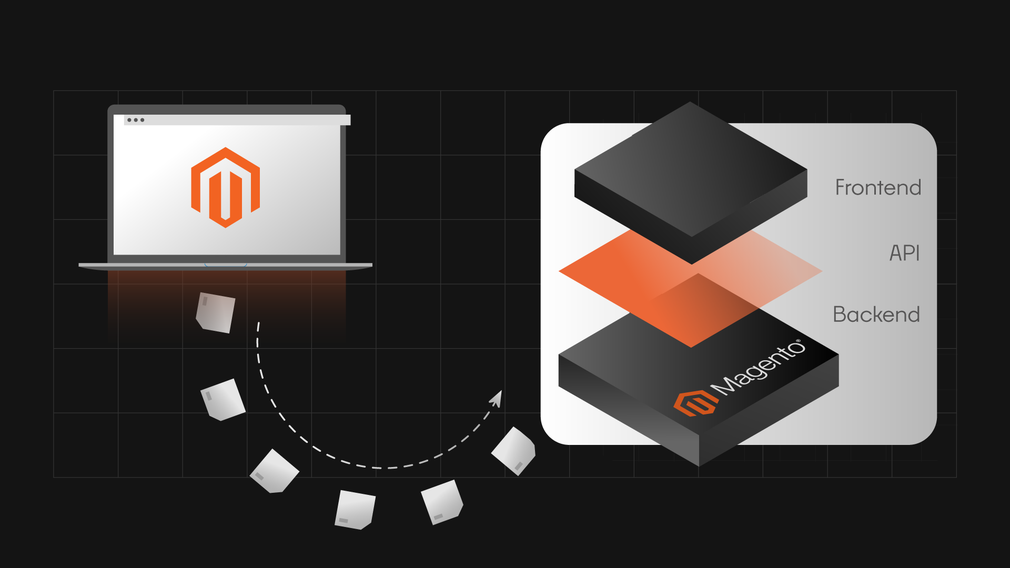
In a Magento Headless setup, Magento handles the heavy lifting on the backend — the commerce engine, product catalog, cart, and orders — while the frontend is a standalone application that talks to Magento via GraphQL (recommended) or REST API.
Most common frontend stacks for Magento Headless in 2026:
Alokai (formerly Vue Storefront) — the most production-ready option on the market
Next.js + custom GraphQL layer — full control; the go-to choice for custom builds
Nuxt.js — the alternative for Vue.js-heavy teams
PWA Studio — Adobe's native solution, but with a shrinking community footprint in 2026
Headless isn't your only modernization path. There are three realistic routes:
Frontend optimization / refactor — improve CWV and clean up code within your existing Magento setup, no architecture changes required
Magento Headless — Magento backend + independent frontend (Alokai, Next.js)
Replatforming / composable — migrate to commercetools, Saleor, or Medusa.js
The right path depends on how many of the 7 criteria below your store actually meets.
7 Measurable Decision Criteria
| Criteria | Decision Threshold | Key Metric |
|---|---|---|
| SKU count and catalog complexity | > 50,000 SKUs or complex configurators | LCP on PLP, reindex time |
| Number of markets | > 2 markets with separate content | Time to launch a new market |
| Deployment frequency | > 1 deploy/month, downtime > 30 min | Lead time, % rollbacks |
| Magento TCO | > 8–12% of annual GMV | Maintenance cost / GMV |
| Core Web Vitals | LCP > 2.5 s, INP > 200 ms | Lighthouse, CrUX, mobile conversion |
| Personalization and A/B testing | 3+ A/B tests/quarter, dynamic content | Personalization uplift |
| AI/IoT/new system integrations | 5+ integrations or AI/IoT on the roadmap | Time to deploy a new integration |
How many of aboves criteria are important to you when making the decision?
0–2 criteria → stay on Magento; consider Frontend Optimization or a Legacy Code Refactor
3 criteria → partial headless (e.g., PLP/PDP only) or a refactor with CWV optimization
4–5 criteria → Magento Headless has a solid business case
6–7 criteria → consider Composable Commerce or replatforming to Medusa.js
Is your e-commerce holding back your growth?
See how our enterprise-class solutions eliminate technical debt and boost conversion rates!
Deep Dive: Selected Criteria
Criterion 1: SKU Count and Catalog Complexity
Magento handles large catalogs just fine on the backend, but the monolithic frontend starts to buckle under 50k+ active SKUs, products with 20+ attributes, and frequent PIM imports. Headless with a dedicated search layer (Algolia, Klevu) solves this without touching any backend logic.
Green flag: < 20,000 SKUs, simple products, once-a-day import
Red flag: > 50,000 SKUs, 20+ attributes, configurators, multi-warehouse, real-time import
Criterion 4: Total Cost of Ownership (TCO) — The Most Overlooked Factor
For a store with PLN 30,000,000 in annual GMV, here's what typical annual Adobe Commerce costs look like:
| Line Item | Adobe Commerce | Magento Open Source |
|---|---|---|
| Adobe Commerce (license) | PLN 120,000–400,000 | PLN 0 (no license fee) |
| Hosting (cloud or on-prem) | PLN 60,000–150,000 | PLN 50,000–120,000 |
| Dev team (2–3 FTE) | PLN 350,000–600,000 | PLN 280,000–480,000 |
| Extensions and integrations | PLN 80,000–180,000 | PLN 60,000–140,000 |
| Version upgrades (mandatory) | PLN 60,000–200,000 | PLN 50,000–160,000 |
| Total TCO | PLN 670,000–1,530,000/year | PLN 440,000–1,200,000/year |
If your maintenance costs are eating up more than 8–12% of GMV, it's time for a Technology Audit to see whether a frontend modernization can bend those numbers down over a 3-year horizon.
Criterion 5: Core Web Vitals and Conversion
Magento with the Luma theme: LCP typically runs 2.8–3.5 s. After Frontend Optimization: 2.0–2.3 s.
Magento Headless with SSR (server-side rendering): 1.0–1.5 s.
Every 100 ms shaved off LCP translates to a 0.5–1% bump in conversion (Google/web.dev data) — at PLN 30,000,000 GMV, that's PLN 150,000–300,000/year in "free" revenue (your traffic acquisition costs stay flat; you just convert more of the traffic you're already paying for).
3 Modernization Paths — Cost Comparison for the Polish Market
| Aspect | Optimization / Refactor | Magento Headless | Composable / Replatforming |
|---|---|---|---|
| What you change | Code and cache layer in Magento | Frontend (new layer) | The entire stack |
| What stays | Magento backend + frontend | Magento backend | Nothing |
| Implementation time | 4–10 weeks | 12–20 weeks | 8–14 months |
| Floor price (PL) | PLN 40,000–50,000 | PLN 250,000 | PLN 400,000+ |
| Typical project (PL) | PLN 80,000–200,000 | PLN 350,000 | PLN 700,000–1,500,000 |
| CWV improvement (LCP) | 3 s → 2.0–2.3 s | 3 s → 1.2 s | 3 s → 1.1 s |
| First results | 2–4 weeks | 6–8 weeks | 12–16 weeks |
| Best fit for | 2–3 criteria met | 4–5 criteria | 6–7 criteria |
Why Magento Headless Hits the Sweet Spot for Most Stores Checking 4+ Boxes
This is the sweet spot for 65–70% of Polish Magento stores operating at this scale. Here's the breakdown:
You protect your backend investment — years of customization, ERP integrations, and historical data, all intact
Independent frontend releases: push campaigns without waiting in the backend deployment queue
Full UX and CWV control with zero SEO risk — as long as the migration is done right with SSR
Phased rollout is on the table — MVP on a specific section (PLP + PDP), then expand from there
Recommended stack: Magento 2.4.x + GraphQL + Alokai or Next.js + Storyblok Headless CMS + Algolia
Magento Headless Implementation Costs in Poland — 2026
| Phase | Timeline | Cost | What You Get |
|---|---|---|---|
| Discovery + architecture audit | 4–6 weeks | PLN 30,000–60,000 | Roadmap, scoped estimate, stack decision |
| MVP (PLP + PDP + cart) | 6–8 weeks | ~PLN 150,000–200,000 | Core purchase flows in Headless |
| Full rollout | 6–10 weeks | Up to ~PLN 700,000 | All sections, integrations, A/B tests |
With a phased approach, you can pump the brakes after the MVP, evaluate the results (typically +10–15% conversion on modernized sections), and then decide whether to pull the trigger on Phase 3. That's the fundamental difference from a big-bang project.
Annual Maintenance After Launch (Polish 2026 Rates)
| Configuration | Annual Cost |
|---|---|
| Small store, 1 dev + agency retainer | PLN 200,000–350,000 |
| Mid-size store, 2 devs + part-time DevOps | PLN 400,000–650,000 |
| Large store, 3–4 devs + tech lead | PLN 750,000–1,100,000 |
Polish dev rates (mid-level PLN 130–180/hr, senior PLN 180–250/hr) run 40–60% below German and UK market rates, which meaningfully lowers the barrier to entry for Polish SMBs going headless.
When NOT to Migrate — and What to Do Instead
Red flags against a full headless migration:
You check fewer than 3 of the 7 criteria
No in-house team or steady technical partner
Your business strategy for the next 24 months is still up in the air
The store has been live less than 12 months or just went through a Magento upgrade
Budget under PLN 250,000 (the floor for Magento Headless)
Alternatives for Every Situation
| Context | Alternative | Ballpark Cost |
|---|---|---|
| Poor CWV, tight budget | Frontend Optimization | PLN 40,000–280,000 |
| High TCO, fuzzy scope | Technology Audit | PLN 30,000–60,000 |
| Legacy code, no documentation | Legacy Code Refactor | PLN 50,000–400,000 |
| Multilingual, multi-market | Multilingual CMS on Storyblok | Per project |
| Getting ready for Headless | Start with a blog (Storyblok), then PLP/PDP — gradual transition | – |
FAQ
Not automatically. The move is justified when you check at least 4 of the 7 measurable criteria. A smaller store with a straightforward catalog can often get the same mileage out of Frontend Optimization (PLN 40,000–280,000) or a Legacy Code Refactor (PLN 50,000–150,000).
Floor: PLN 250,000. A typical mid-size store project: around PLN 350,000. Complex deployments (B2B, multi-market, advanced ERP integrations): up to PLN 700,000. Add annual maintenance on top: PLN 200,000–650,000/year depending on scale.
Stores on 2.4.6 need to move to 2.4.8-p4 (currently stable) or wait for 2.4.9 GA (May 2026). The upgrade typically takes 2–6 weeks and costs PLN 60,000–200,000. It's a natural checkpoint to run a parallel analysis of whether to roll frontend modernization into the same engagement.
Yes — and that's the recommended path for Polish SMBs. The MVP covers the core purchase flows (PLP + PDP + cart) and is ready in 6–8 weeks. First results (LCP < 1.5 s, conversion lift) typically show up 30–45 days after launch.
Frontend Optimization (PLN 40,000–280,000) wins when CWV is your primary pain point, your budget doesn't stretch to PLN 250,000, and the other criteria (SKU count, markets, integrations) simply don't apply to your situation. Go with Magento Headless when — on top of performance — you need a unique UX, omnichannel capability, or the ability to ship campaigns without waiting on the backend.
It can, if the migration is botched. The non-negotiables: a complete 301 redirect map, preserved URL structure, proper SSR/ISR implementation, hreflang and canonical tags untouched. Done right, a headless migration typically improves SEO thanks to better CWV — LCP drops from 3 s to 1.2 s.
No. Magento 2 works great as a headless backend thanks to its robust GraphQL support. Replatforming only makes sense when technical debt is through the roof or there's a fundamental business model shift (e.g., pivoting from B2C to a marketplace model).
Small store: 1 frontend dev + agency retainer (~PLN 25,000–35,000/month). Mid-size: 2 devs + part-time DevOps (PLN 35,000–55,000/month). Large: 3–4 devs + tech lead. The Magento backend is maintained by the same people who handle it today.
Summary
Score your store against the 7 criteria — use hard numbers, not gut feelings
Add up the points — 0–2: stay put / 3: partial headless / 4–5: Magento Headless / 6–7: replatforming
Factor in the 2026 deadline — the Magento 2.4.6 upgrade must happen before August; it's a natural hook to fold in a frontend analysis at the same time
Start with discovery, not migration — 4–6 weeks of upfront analysis gives you a precise quote and keeps risk in check
Go phased — MVP in 6–8 weeks, full rollout in 12–20 weeks, with a clear off-ramp after each phase


Our Experts

Frontend Developer with hands-on experience in Magento and Shopify. One of the few Storyblok implementation specialists in the market. At Beecommerce for 8 years.

Senior Full Stack Developer with 20 years of experience. Expert in PHP, Java, and Python. Certified Magento specialist with 7 years in the platform.
Let's talk about potential areas of collaboration!
Hi!
during the first consultation we'll analyze your goals through the lens of ROI and operational risk. Whether we're building an Enterprise system, an application, or an AI automation — together we'll plan an architecture that eliminates your technical debt and unlocks scalability.


You can find more articles on this topic on our blog

Headless CMS for Marketing 2026: E-commerce Guide
Discover how Headless CMS transforms e-commerce and marketing. A complete guide for store owners and managers, including Storyblok and ROI.
8 min
Read more

Comparison of Headless CMS and No-Code Website Builders.
Content management systems. Comparison of headless and no-code solutions.
6 min
Read more

Headless Technology on a Traditional E-commerce Platform
Headless Online Store vs. Traditional E-commerce Platform: How to Go Headless Before Implementing Composable Technology.
6 min
Read more