


Hidden costs and red flags: how to choose an e-commerce partner to avoid overspending and project failure
As of: Q3 2026 | Reading time: 9 min
TL;DR – In Brief
The Total Cost of Ownership (TCO) for an e-commerce platform is typically 3–4 times higher than the initial implementation quote. This represents a common pitfall that the majority of businesses encounter.
A mature technology partner insists on a discovery phase (4–8 weeks, $5,000–$12,500) and is capable of proposing Fixed Price or Outcome-Based billing, not solely a flexible Time & Material model.
Source code and IP ownership must belong to you from day one. This isn't a mere standard; it's a non-negotiable condition you must explicitly demand in your contract.
Major red flags: a fixed quote without prior analysis, a lack of verifiable case studies within your specific industry, and consolidated invoices that are not itemized by individual tasks.
An SLA (Service Level Agreement) without specific metrics (e.g., 99.9% uptime) and contractual penalties (service credits) for non-compliance is essentially worthless. Often, an SLA also provides access to faster support for new feature development.


Choosing a technology partner is one of those pivotal decisions you make once every few years, yet its repercussions are felt daily. Often, this process resembles buying a used car: we tend to focus on the price and promises, largely ignoring what's truly hidden under the hood. And there, lurking beneath the surface, are hidden costs, technical debt, and risks that can bury not just the project itself, but also the crucial trust of your customers.
The harsh reality is this: opting for the wrong partner incurs expenses far exceeding the mere invoice amount. It means lost conversions, significant drops in SEO rankings, profound team frustration, and in extreme cases, operational paralysis. Let's pause for a moment. Instead of asking "how much will this cost?", let's shift our focus to the question, "what does a mature partnership that genuinely delivers a return on investment look like?" This article serves as a comprehensive guide on how to effectively distinguish a strategic partner from a mere vendor.
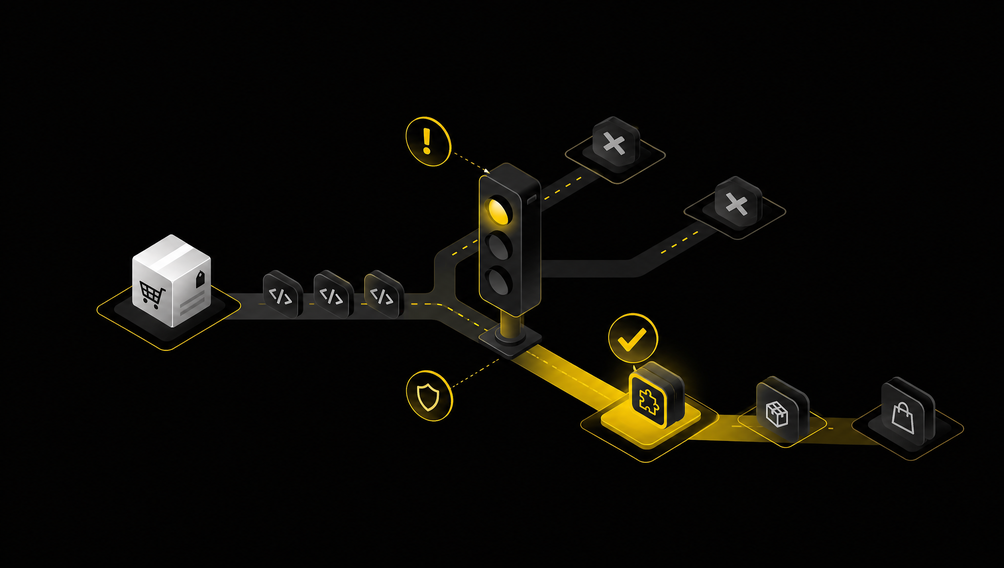
Signs of a Mature E-commerce Partner: What to Look For
A mature partner understands that the price quoted on an offer is merely an upfront payment. The true Total Cost of Ownership (TCO) for a platform is frequently 3 to 4 times higher than the initial implementation cost. A seasoned partner will directly and forthrightly ask if you've adequately accounted for this cost in your P&L. This is precisely why you're not just looking for a contractor, but rather a long-term ally who will evolve alongside your business and assist you in meticulously planning your company's future financial flows.
Engagement Model: Flexibility or Rigid Frameworks?
Most professional e-commerce agencies will initiate discussions by proposing a discovery phase or analytical workshops. This clearly signals their intent to first thoroughly understand your business, and only then proceed to write any code. You should actively avoid companies that send estimates without conducting a workshop—the scope will likely be intentionally underestimated, and you'll either end up with a completely missed project or find yourself paying 5–10 times more trying to make the project genuinely usable. In the first scenario, you lose valuable time; in the second, you lose significant money. Commencing with a thorough analysis of challenges is directly reflected in the various billing models available.
The most straightforward way to grasp this distinction in approach is by examining two distinct cooperation models.
| Feature | Time & Material (T&M) | Fixed Price |
|---|---|---|
| Scope Definition | Flexible, evolving with the project | Rigid, precisely defined at the outset |
| Client Risk | High (you pay for actual hours worked but don't know their total extent) | Medium (risk of overpaying for a "safety buffer") |
| Vendor Risk | Lower (no pressure to cut quality; scope and compensation can grow organically) | Higher (risk of underestimation and potential losses) |
| Transparency | High (detailed hourly reporting) | Medium (single lump sum, no insight into costs; billed for completed functionalities or the entire project) |
| Best For | Complex projects and R&D, where quality and continuous adaptation are key | Repeatable implementations with a fixed scope, AI-powered deployments |
Regardless of the chosen billing model, a thorough discovery phase remains the undeniable hallmark of a mature partner. Nowadays, thanks to advancements in AI, the Discovery workshop is conducted significantly faster and with greater accuracy than ever before. A phase that once only the largest corporations could afford is now readily available at a mere fraction of its former cost. The automatic synthesis of meeting insights, deep research, and comprehensive report generation drastically accelerate the pace of building robust pre-implementation documentation. In the T&M model, you might now encounter an additional cost in the form of tokens. Since development work is expedited through AI, the vendor will typically aim to charge you for these token costs to preserve their initial profit margin. In Fixed Price projects, the cost of tokens is usually seamlessly integrated into the overall price.
Transparency and Business Acumen
A mature partner operates with complete transparency. From day one, they provide you with full access to the code repository, clearly communicate progress within systems like Jira, and never sweep problems under the rug. More importantly, such a partner doesn't just write code; they possess a deep understanding of your business. They inquire about your strategic goals, profitability, logistical challenges, and competitive advantages, rather than simply asking for a list of features to deliver.
Verifiable case studies from projects of comparable scale and complexity are an invaluable indicator when evaluating a potential partner. Always look for concrete proof, not just empty promises. If you're planning a B2B implementation involving hundreds of thousands of SKUs, you unequivocally need a partner who has successfully tackled such projects before, not one who "will gladly learn" using your budget. Additionally, remember that writing code with AI is progressively becoming more affordable, and in many instances, the vendor's specialized domain knowledge holds greater value than specific experience with a particular technology.
Key Questions Before Signing the Contract: Secure Your Business
Once you find a partner who speaks the language of value, rather than merely price, it's time for a meticulous analysis of the contract. The devil, as they say, is truly in the details, and overlooking these specifics could potentially cost you hundreds of thousands of dollars.
Before you affix your signature, ensure you have clear, unambiguous, and written answers to the following essential questions.
| Issue | Question to Partner | Expected, Non-Negotiable Answer |
|---|---|---|
| Code & IP Ownership | Who retains ownership of the source code and intellectual property? | The client, typically from the moment the invoice is paid. |
| Repository Access | Will I be granted full access to the code, CI/CD processes, and all relevant documentation? | Yes, full and unrestricted access to GitHub/GitLab and Jira/Confluence. Work can often be performed directly on the client's repository. |
| SLA Agreement | What are the specific commitments regarding platform availability and response time? | 99.9% availability, a 4-hour response time for critical errors, and service credits for any violations. Access to faster paid support within the SLA. |
| Vendor Lock-in | What provisions are in place concerning data export and support during a potential migration? | Full data transferability, no lump-sum fees for data export, and comprehensive support for migration to another provider. |
| Post-Implementation Support | What does the support and ongoing development model look like after project completion? | A clearly defined model (e.g., an hourly retainer), guaranteed team availability, and a structured bug reporting process. |
| Testing & Quality (QA) | What are your established processes for testing and quality control? | A multi-level process: automated tests, manual tests, User Acceptance Testing (UAT), and thorough code reviews. |
Code ownership represents a critical issue. By default, the code's creator is its owner, unless the contract explicitly states otherwise. Therefore, you must ensure your agreement clearly transfers all such rights to you. Equally important is the SLA. Vague promises of "best efforts" are, in practical terms, worthless. According to ITIC's 2024 report, an hour of downtime costs over $300,000 for 90% of Enterprise sector companies. A robust SLA is, in essence, your crucial insurance policy.
Red Flags: Warning Signs You Can't Ignore
The selection process can be complex and challenging, but certain signals should immediately raise a significant red flag. Choosing to ignore them is, frankly, asking for trouble.
Here's a list of specific behaviors that should prompt you to politely walk away from a potential partnership.
| Red Flag | Potential Consequence | How to Protect Yourself |
|---|---|---|
| Fixed Price offer without Discovery | A hidden, high price buffer — or underestimation leading to cut corners on quality. | Require a discovery phase (30,000–60,000 PLN, 4–8 weeks) or a technology audit. |
| No verifiable case studies | No experience in your industry or at your scale. Risk of becoming a guinea pig. | Ask for 2–3 concrete references and contact previous clients directly. |
| Non-itemized invoices | Hidden costs, lack of spending control, difficulty assessing efficiency. | Require detailed hourly reports and clear rates for every role on the team. |
| No direct access to the team | Poor communication, delays, technical solutions misaligned with business needs. | Secure the right to regular meetings and direct contact with the team in the contract. |
| Push for a single technology | The partner is promoting what they know, not what your business actually needs. | Require an objective comparison of several technology options against your goals. |
| No risk management plan | Unforeseen issues (a developer leaving, an API change) can stall the project. | Ask about contingency plans and how key risks will be mitigated. |
A "fixed" offer delivered without any prior analysis is, without a doubt, the biggest trap. Research from Panorama Consulting consistently indicates that 50–75% of IT projects exceed their allocated budget, primarily due to inaccurate or insufficient analysis conducted at the outset. You should actively avoid companies that promise unrealistically low prices and impossibly short deadlines. This is a direct and perilous path to disaster if your project entails more than just a simple prototype.
Total Cost of Ownership (TCO): Three Modernization Paths in 2026
The true 5-year TCO for an e-commerce platform is, as Gartner estimates, 3–4 times more than the initial implementation cost. This comprehensive figure encompasses licenses, hosting, ongoing maintenance, integrations, and continuous development. With this critical understanding in mind, you are faced with a strategic choice among three distinct modernization paths.
Full Replatform to Composable Commerce:
What it is: Building a modular ecosystem completely from scratch, utilizing best-in-class components (e.g., Medusa.js as the e-commerce engine, Storyblok as the CMS, Algolia as the search engine).
Who it's for: Companies with GMV exceeding $7.5M, those targeting international expansion, and businesses requiring the utmost flexibility.
Average cost in Poland: from $200,000 net.
Time to first impact: 12–16 weeks.
Conclusion: This path entails the highest initial cost, but offers the lowest TCO over a 5-year perspective and effectively eliminates vendor lock-in. It represents a strategic investment in the future.
Modernization of an Existing Platform (e.g., Magento Headless):
What it is: Retaining a proven backend (e.g., Magento 2) and replacing solely the front-end layer with modern technology (e.g., Next.js).
Who it's for: Companies with substantial investment in an existing backend that require immediate performance improvements (Core Web Vitals) and enhanced marketing flexibility.
Average cost in Poland:
Magento Headless: $87,500 net.
Shopify Hydrogen: $80,000 net.
Time to first impact: 4–8 weeks.
Conclusion: This option represents the sweet spot. It delivers significant improvement in customer experience and conversion at a lower cost and reduced risk compared to a full replatform.
Code Refactoring and Front-End Optimization:
What it is: Concentrating efforts on "cleaning up" existing code, diligently eliminating technical debt, and optimizing the front-end specifically for Core Web Vitals.
Who it's for: Companies operating with limited budgets that require quick, measurable results in conversion and SEO.
Average cost in Poland:
Legacy Code Refactoring: $37,500 net.
Front-End Optimization: $30,000 net.
Time to first impact: 2–4 weeks.
Conclusion: This delivers the fastest ROI. While it doesn't fundamentally solve architectural problems, it can significantly boost conversion by several to tens of percent within a single quarter.
To facilitate a clearer comparison, we've diligently gathered key data into a single, comprehensive table.
| Scenario | Average Cost (Net USD) | Implementation Time | First Impact | Key Benefit |
|---|---|---|---|---|
| Composable Commerce | $200,000 | 6–12 months | 12–16 weeks | Maximum flexibility and scalability |
| Magento Headless | $87,500 | 12–20 weeks | 6–8 weeks | Front-end performance without backend replacement |
| Shopify Hydrogen | $80,000 | 8–14 weeks | 4–6 weeks | Custom front-end on stable Shopify Plus |
| Legacy Code Refactoring | $37,500 | 3–6 months | 4–6 weeks | Stability and development pace without replatforming |
| Front-End Optimization | $30,000 | 4–10 weeks | 2–4 weeks | Measurable CR and SEO growth without touching the backend |

As you can clearly see, the choice is far from simple and is heavily dependent on your specific strategy, available budget, and overall appetite for risk. The most crucial aspect is to make this decision consciously, fully understanding all the inherent pros and cons.
FAQ: Common Questions About Choosing an E-commerce Partner
Far more than the invoice amount. It's the cost of lost sales due to frequent downtimes, lower conversion rates stemming from poor performance, higher traffic acquisition costs due to weak SEO, and the substantial expense of rectifying technical debt, which can often exceed the original implementation cost
It refers to a dependency on a single vendor's technology or services, making any future change either prohibitively costly or virtually impossible. You can effectively avoid it by opting for open technologies, ensuring full ownership of your code and data, and choosing a modular architecture, such as with Storyblok Headless CMS.
The three fundamental pillars are: a guaranteed level of availability (e.g., 99.9%), a clearly defined maximum response time for incidents (e.g., 4 hours for critical errors), and contractual penalties (service credits) specifically for failing to meet these agreed-upon conditions.
Yes, absolutely. It's akin to an architectural design process before constructing a house. Skipping it is, in essence, asking for a construction disaster. The discovery phase (typically lasting 4–8 weeks) significantly minimizes risk, precisely clarifies the project scope, and enables a much more accurate cost estimation.
Absolutely. This undoubtedly represents the smartest and most prudent approach. Initiating with a Rapid MVP Creation project allows you to swiftly validate an idea, gather crucial data, and minimize financial risk by delivering tangible business value in manageable stages.
Summary: Choose a Partnership, Not Just a Vendor
Choosing a technology partner is a strategic decision, not merely a procurement bid for the cheapest offer. It is imperative to look beyond the initial price—diligently analyze the Total Cost of Ownership (TCO), transparency, flexibility, and the potential for a long-term, truly partnership-driven relationship.
Remember, a mature partner is one who:
Insists on a discovery phase and generally prefers a flexible Time & Material model.
Guarantees you full ownership of the code and complete access to all project resources.
Proposes a concrete Service Level Agreement (SLA) with measurable parameters.
Possesses a robust project portfolio that clearly demonstrates their competence.
A conscious decision based on these critical criteria will effectively protect your business from unforeseen hidden costs and provide it with a stable and resilient foundation for sustained growth. It is, in essence, an investment that consistently yields substantial returns many times over.
Sources
ITIC's 2024 Hourly Cost of Downtime Report (ITIC, 2024) — <https://www.itic-corp.com/blog/2024-hourly-cost-of-downtime-report>
The hidden cost of certainty: Why fixed price contracts are more expensive than you think (Devtimate, 2023) — <https://devtimate.com/blog/the-hidden-cost-of-fixed-price-contracts>
Just Join IT – IT Salary Report (Just Join IT, 2026) — <https://justjoin.it/blog>
Web.dev (Google) — <https://web.dev/>
Panorama Consulting Group (Panorama Consulting) — <https://www.panorama-consulting.com/>
Are you currently facing a decision on choosing a technology partner? Do you want to proactively avoid hidden costs and ensure predictable, sustained development? Contact BeeCommerce: contact@beecommerce.pl. We'll assist you in conducting a comprehensive technology audit and developing a tailored strategy that effectively secures your business for years to come. We consistently begin with a discovery phase (4–8 weeks) to accurately and concretely estimate both the scope and the associated cost.


Więcej artykułów na ten temat znajdziesz na naszym blogu

AI in field sales: how an AI assistant is reshaping the Rep's job and company results in 2026
Discover how an AI sales assistant automates reporting, optimizes routes, and boosts sales efficiency. Stop spending evenings updating your CRM.
10 min
Read more

Clickable prototype over a 50-page spec in e-commerce
Why a clickable backoffice mockup speeds up board decisions in e-commerce projects and cuts implementation risk. A practical guide.
9 min
Read more

Seamless store migration: how to plan your cutover and mitigate risk
Planning an e-commerce store migration? Learn how to choose a cutover strategy (big-bang vs. strangler), minimize downtime, and monitor the first 72 hours post-launch to protect your sales and rankings.
12 min
Read more