



API - Application Programming Interface in Practice
In the dynamic world of e-commerce, applications without APIs are increasingly seen as outdated, unable to meet modern demands. They can be compared to computers from the pre-USB era in the 90s, which, without that standard, had limited connectivity options with modern devices. The lack of an API hinders seamless integration with payment systems, warehouse tools, or marketing platforms. An API, like a universal interface, powers modern online stores, enabling efficient communication, integration, and continuous development.
From this post, you'll learn what an API is, how an API works, and why it is crucial for your online business, for both e-commerce owners and developers.
What is an API? The Key to Digital Communication
API, or Application Programming Interface, is a set of rules, protocols, and standards that enable communication between different systems. Thanks to this, your online store can automatically exchange data, integrate with external services, and streamline processes.
Imagine an API as a waiter in a restaurant:
Frontend (client): specifies what you need – e.g., a list of products, prices, or order details.
Backend (kitchen): stores data, processes business logic, and prepares responses.
API (waiter): takes your needs, passes them to the backend, and delivers the responses.
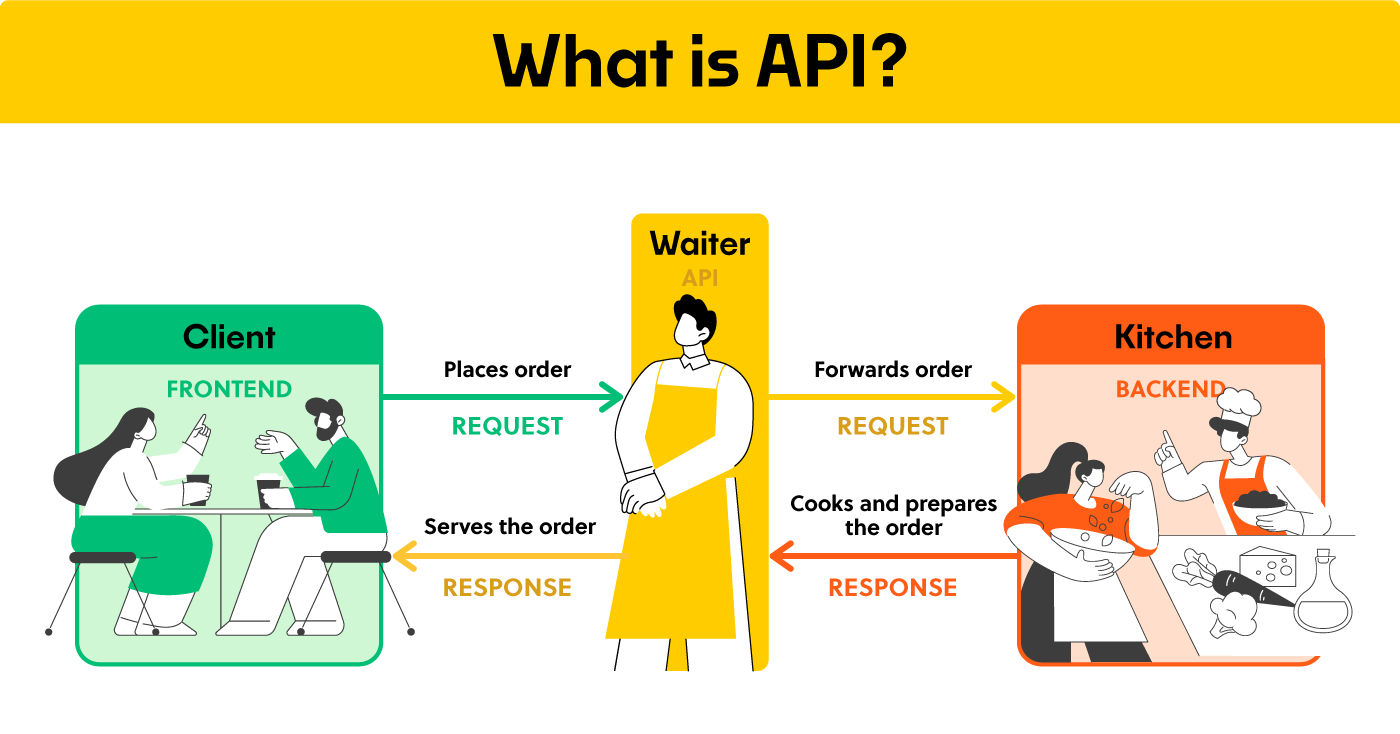
Without it, communication between layers would be chaotic, and e-commerce would be more technically challenging to maintain. The application programming interface connects applications and provides functionalities such as Google login or automatic inventory updates.
For e-commerce owners, this means a more efficient connection between the store and external tools, which accelerates development and improves the customer experience. For developers, it's a standard way to access data and functions, based on predictable rules and documentation.
How Does an API Work?
An API operates on a standard Request-Response communication method. An application sends a request to the application programming interface, which communicates with the server and returns a response, most often in JSON or XML data format. Key elements include:
Endpoints: URL addresses pointing to specific resources or functions, e.g.,
GET /productsto retrieve a list of products.HTTP Methods: Specify actions, such as
GET(retrieving data),POST(creating resources),PUT(updating), orDELETE(deleting).API Keys: Ensure security through authentication, authorization, and mechanisms to prevent overload or unequal access to resources.
API Documentation: Essential for developers, it describes endpoints, parameters, and possible responses (e.g., in Swagger or Postman format).
Example: A customer adds a product to the cart, and the frontend sends a POST /cart request with product data. The API passes it to the backend, which updates the cart and returns a confirmation.
How Does an API Work?
An API operates on a standard Request-Response communication method. An application sends a request to the application programming interface, which communicates with the server and returns a response, most often in JSON or XML data format. Key elements include:
Endpoints: URL addresses pointing to specific resources or functions, e.g.,
GET /productsto retrieve a list of products.HTTP Methods: Specify actions, such as
GET(retrieving data),POST(creating resources),PUT(updating), orDELETE(deleting).API Keys: Ensure security through authentication, authorization, and mechanisms to prevent overload or unequal access to resources.
API Documentation: Essential for developers, it describes endpoints, parameters, and possible responses (e.g., in Swagger or Postman format).
Example: A customer adds a product to the cart, and the frontend sends a POST /cart request with product data. The API passes it to the backend, which updates the cart and returns a confirmation.
Types of Application Programming Interfaces in E-commerce
These are categories of application – they focus on what the API is intended for and for whom, rather than technical details.
Public API (Open): Available to any developer, e.g., Google Maps API, Twitter API, or OpenWeather API. They allow applications to be enriched with external data, e.g., maps in an online store. Application: In e-commerce, they enable adding functions such as location services.
Private API (Internal): Used within a single organization, ensuring security and process consistency. Example: For communication between CRM and ERP systems within a company. Application: Crucial for managing internal processes in e-commerce.
Partner API: Made available to trusted partners, e.g., logistics service providers or payment platforms, with higher access limits. Application: They enable cooperation with external services, e.g., integration with DHL or Stripe.
Data Analysis API: Used for monitoring keywords, website traffic, or user behavior. Example: Google Analytics API or SEMrush. Application: Support SEO in marketing, optimizing campaigns, and search engine visibility.
System API: Connects warehouse management software (WMS) or logistics software, e.g., DHL API for tracking shipments. Application: Automates logistics processes in e-commerce.
Library and Framework API: Provide ready-made functions in libraries, e.g., JavaScript. Application: Used by IT specialists to accelerate application development.
Hardware API: Enable communication with devices, e.g., in IoT. Application: Less commonly used in e-commerce, but can support smart kiosks, for instance.
Browser API: Enable interactions with browsers, e.g., for dynamic pages. Application: Key in building mobile and web applications.
File Management API: Enable file operations, e.g., in CMS systems. Application: Useful for coordinating content in e-commerce.
SQL API: Enable access to databases through SQL queries. Application: Used in systems requiring direct data reading.
These categories thus concern the business context, availability, and functions they fulfill in the application ecosystem.
Types of Application Programming Interfaces - Classification by Architecture and Technology
API types refer to how it is designed and operates at a technological level, meaning the protocols, standards, and communication mechanisms. They focus on how it processes requests and responses, what data formats it uses, and what architectural approach it employs.
REST API (Representational State Transfer): Based on the HTTP protocol and CRUD operations (Create, Read, Update, Delete), such as GET, POST, PUT, and DELETE. Characterized by simplicity, flexibility, and broad support in every programming language. Data is most often transmitted in JSON format. Example:
GET /productsretrieves a list of products.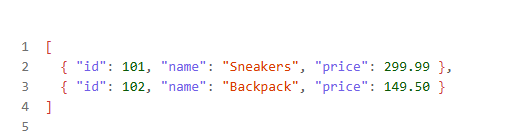
RESTful API is synonymous with scalability, ideal for headless commerce and mobile applications. Thanks to unambiguous resource addressing and the use of standard HTTP methods, the REST API is easy to test, monitor, and document. Application: The dominant standard in e-commerce due to ease of integration, real-time data access, and compatibility with frontends like SPA (Single Page Application).
SOAP API (Simple Object Access Protocol): Based on XML and offers built-in security standards (WS-Security) and transactional capabilities. It is more formalized, with strictly defined messages (SOAP Envelope). Less popular in modern e-commerce, it is being replaced by REST and GraphQL due to greater complexity. Application: Used in older systems, e.g., banking, where high reliability is required.
GraphQL API: Developed for Facebook, it's an innovative query language that allows the client to precisely specify what data they want to receive, minimizing network traffic. Ideal for headless commerce, where speed and flexibility are key. Example: A GraphQL query can retrieve only the product name and price, instead of the full object. Application: Increasingly popular in e-commerce due to excellent frontend integration. It excels in applications that require different data on each page.

An innovative query language that allows precise specification of what data to receive, minimizing network traffic. Ideal for headless commerce due to its query efficiency (precise data retrieval) and extremely convenient combination of data from other systems into one API.
RPC API: Less popular, focused on remote procedure calls. Used in specific cases, e.g., in internal systems.
It focuses on calling remote procedures, not resources.
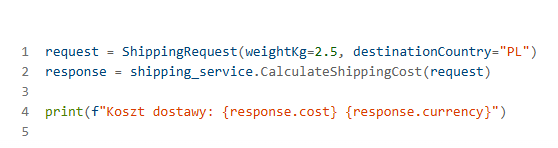
Less popular in e-commerce, used in specific internal systems, such as IoT (Internet of Things). Application: Found in accounting and ERP systems, facilitating data exchange with invoices. Less commonly used in modern web applications.
For developers: REST API and GraphQL API are standards in e-commerce, appreciated by veterans and beginners alike, offering flexibility and simplicity. Business owners will appreciate GraphQL for faster page loading and better UX.
API types, therefore, concern the form of the API, API procedures, and the way the API allows for technical communication. They are particularly important for developers who design and integrate systems.
Types and Kinds of APIs - Summary of Differences
As you can see, the application programming interface should be considered from each of these perspectives. To further simplify the understanding of this division, I have prepared points below indicating the differences between types and kinds.
Classification Perspective:
Types concern technology, architecture, and operating mechanisms (e.g., REST, SOAP, GraphQL).
Kinds refer to application and availability (e.g., public, private, system).
2. Technical Level:
Types are more technical, mainly of interest to developers designing systems.
Kinds are relevant to business owners and developers because they determine how and where an API can be used.
3. Examples in E-commerce:
Type: The choice between REST API and GraphQL API affects how quickly a store page loads data (e.g., in headless commerce).
Kind: The decision to use a public (e.g., Google Maps) or private API (e.g., an internal ERP system) depends on business needs.
4. Occurrence in Practice:
Types define how an API works technically, e.g., what API protocols it uses (HTTP, XML).
Kinds determine what an API is used for, e.g., for data analysis or automation.
Zastosowania w e-commerce
Dla lepszej wizualizacji zastosowania tego w Twoim biznesie znajdziesz też przykłady użycia API w ecommerce:
Applications in E-commerce
For better visualization of its application in your business, you'll also find examples of API usage in e-commerce:
Type: An online store uses a REST API to retrieve a list of products (
GET /products) in JSON format, which speeds up page loading. Alternatively, a GraphQL API allows retrieving only the product name and price, optimizing network traffic.Kind: The store integrates with the public Stripe API for payment processing and a private internal API for synchronizing inventory levels with the WMS system.
Rodzaj
Sklep integruje się z publicznym API Stripe do obsługi płatności, a prywatnym API wewnętrznym do synchronizacji stanów magazynowych z systemem WMS.
Examples of APIs in Everyday Life
APIs revolutionize e-commerce through practical applications:
Payments: APIs of operators like Stripe, PayU, or Blik ensure secure transaction processing and status updates.
Logistics: Integration with courier companies (DPD, DHL, UPS) automates label generation, parcel tracking, and returns management.
Invoicing: Accounting systems (e.g., Fakturownia) automatically generate documents thanks to APIs.
Marketing Automation: APIs of tools like Mailchimp or Klaviyo enable customer segmentation and sending personalized campaigns.
WMS and ERP Systems: APIs synchronize inventory levels and product data in real-time.
SEO and Data Analysis: APIs of tools like Google Analytics or SEMrush provide data on keywords and user behavior.
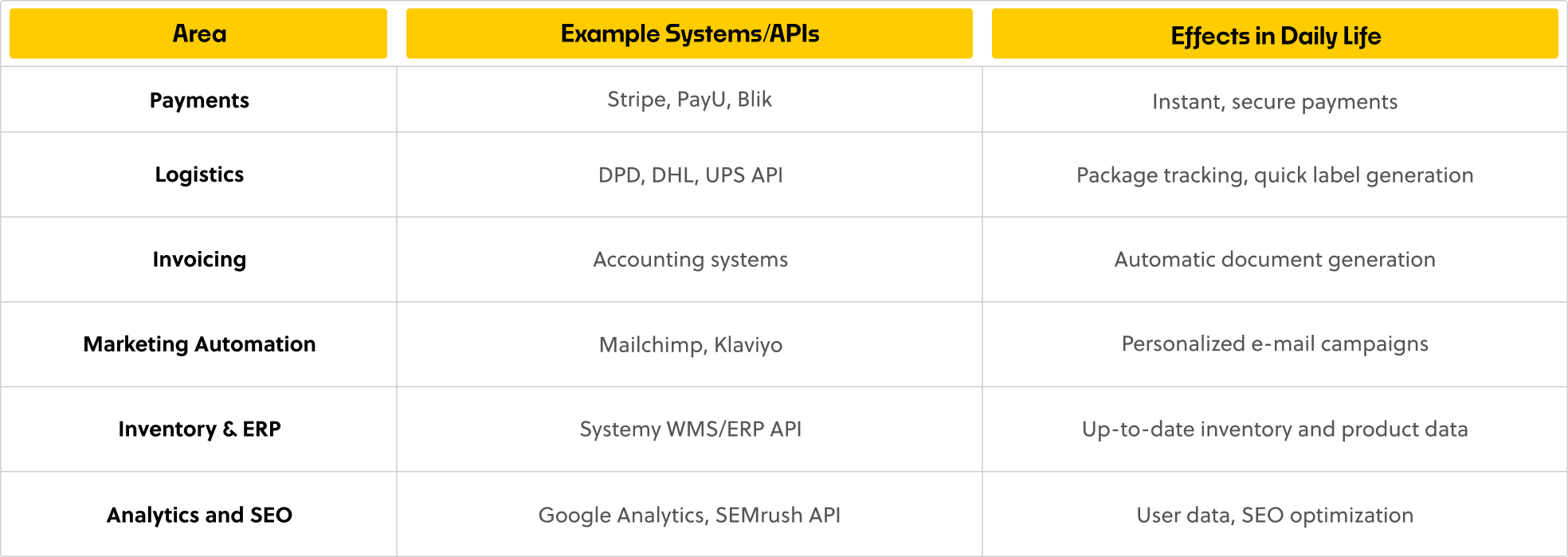
Example: The Stripe API verifies payments in real-time, and the DHL API generates a shipping label after an order is placed. This saves time and eliminates errors.
What Does API Mean for Marketing and SEO?
Effective marketing and SEO are key to e-commerce success, and APIs play an important role here:
Keyword Analysis: APIs of tools like Google Keyword Planner or SEMrush provide data on the popularity of phrases, e.g., "what is API" or "API interface," enabling the creation of optimized content.
Campaign Automation: APIs of platforms like Klaviyo or HubSpot allow sending personalized emails, e.g., about abandoned carts.
Traffic Monitoring: The Google Analytics API provides user data, supporting UX and conversion optimization.
For e-commerce owners, APIs in marketing mean precise campaigns and better search engine visibility. For developers, it's the ability to synchronize with analytical tools without writing code from scratch.
Advantages of Using APIs in E-commerce
APIs are the fuel for e-commerce. Key benefits:

System Integration:
Connects CRM, ERP, PIM, payments, and logistics into a single ecosystem

Scalability:
Separates frontend from backend, allowing independent development of layers.

Speed:
Loading only necessary data speeds up the site, improving UX and SEO.

Omnichannel and Personalization:
APIs support mobile applications, websites, and voice assistants.

Automation:
Eliminates manual processes, such as invoicing or inventory updates.

Innovation:
Enables rapid implementation of new functionalities thanks to ready-made API tools.

API Security:
Keys and tokens (e.g., OAuth) protect data.
Challenges Associated with APIs
Despite the benefits, APIs come with challenges:
Security: Requires authorization (e.g., OAuth) and abuse monitoring.
Rate Limits: Some APIs have restrictions, requiring optimal management.
Updates: Changes in the API may require code adaptation.
Developers must design systems with these challenges in mind, and business owners should work with experienced partners to minimize them.
Endpoints - Contact Points for Your Data
Endpoints are the URL addresses where API resources are available. Examples:
GET /products– list of products.POST /cart– adding a product to the cart.GET /orders/{orderId}– order details.
Reliable API documentation (e.g., Swagger) is crucial for developers, and for business owners, it means easy implementation of new features.
API - The Foundation of Headless Commerce Architecture
Headless commerce separates the frontend from the backend, and the API connects these layers. This allows you to use different technologies (e.g., React for the frontend, Shopify for the backend). API-first and composable commerce integrate tools into a coherent ecosystem, providing flexibility, scalability, and rapid deployments.
API - Your Key to the Future of E-commerce
API is the foundation of modern e-commerce, enabling system integration, automation, marketing optimization, and scalability. Thanks to APIs, stores operate faster and more efficiently. At BeeCommerce, as experts in headless commerce, we help build API-first platforms that drive business growth. Contact us and start building a modern, scalable online store today!


Let's talk about potential areas of collaboration!
Hi!
during the first consultation we'll analyze your goals through the lens of ROI and operational risk. Whether we're building an Enterprise system, an application, or an AI automation — together we'll plan an architecture that eliminates your technical debt and unlocks scalability.


You can find more articles on this topic on our blog
API: Application Programming Interface in Practice
Discover what an API (Application Programming Interface) is and how it facilitates seamless integration and communication between various software and applications.
9 min
Read more
The Backend Iceberg: Why Your E-commerce Is Sinking Even When Everything Looks OK on the Surface
E-commerce Analysis for 2026: Discover what's holding your online business back from growing. Learn how the hidden costs of backend maintenance impact your profitability.
5 min
Read more

Technical Debt: The Hidden Cost of "Fast" Deployments. How to Stop Technology from Holding Your E-commerce Back?
Find out what technical debt is and why this hidden cost is holding back your e-commerce system. Learn how to effectively reduce the costs of technical debt.
6 min
Read more